Ivory Coast
The world's leading cocoa producer and the economic engine of French-speaking West Africa, where many peoples live around its great city, Abidjan.
largest city: Abidjan
+ Dioula, Baoulé, Bété… (~60 languages)
At a glance
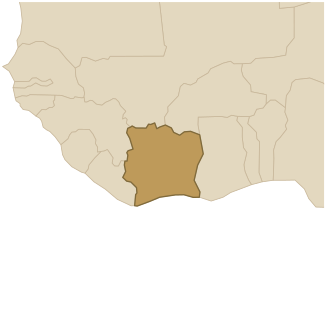
Ivory Coast lies on the Gulf of Guinea in West Africa, stretching from its coastal lagoons to the savannas of the north. More than thirty million people live there, many of them in the huge city of Abidjan, the country's economic centre and one of the largest cities in French-speaking Africa; the official capital is Yamoussoukro. Long one of the most prosperous countries in the region, Ivory Coast owes its wealth to a bean: cocoa, of which it is by far the world's largest producer.
Geography
The land slopes gently down to the sea. The south is covered in humid rainforest, where cocoa, coffee and rubber grow, with a coast of lagoons and beaches. Further north, the forest gives way to drier savanna, cattle country, up to the edge of the Sahel. In the west a few mountains rise around Mount Nimba and its reserve. Farming long made the country rich.
Peoples and history
Ivory Coast has some sixty peoples, in a few large groups: the Akan (including the Baoulé) in the centre and east, cousins of the Ashanti of Ghana; the Mande and Senufo in the north; the Kru in the south-west. They had kingdoms and chiefdoms before France turned the country into a colony, run mainly for its farm produce. At independence in 1960 the country got a long-serving president, Félix Houphouët-Boigny; under his rule the cocoa boom led people to speak of an "Ivorian miracle", and he had one of the largest basilicas in the world built in his home town, Yamoussoukro. After his death in 1993, the country went through a long crisis and two civil wars, until 2011, before growth returned.
Languages and religion
Some sixty languages are spoken in Ivory Coast; Dioula is the language of trade across much of the country, and French, inherited from colonisation, is the official language and the language of school, spoken with a very Ivorian flair (the famous "nouchi" slang of Abidjan's streets). The country is split between a mostly Muslim north, a mostly Christian south, and traditional religions that are still alive, with their masks and rites.
Culture and way of life
Ivory Coast is a major centre of modern African music: after the zouglou of Abidjan's students came coupé-décalé, launched in the early 2000s by Ivorians in Paris and then Abidjan, which got the whole continent dancing. The country is passionate about football and its national team, the Elephants. People eat attiéké, a cassava couscous served with fish or grilled chicken, and foutou. Baoulé and Dan masks, loaded with sacred meaning, are among the most admired in Africa.