Faroe Islands
A windswept Nordic archipelago in the middle of the North Atlantic, a self-governing territory of Denmark, a Viking land of cliffs, sheep and turf-roofed villages.
At a glance
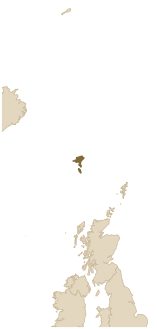
The Faroe Islands are a small, isolated Nordic archipelago in the North Atlantic, between Scotland, Iceland and Norway. They are a self-governing territory of the Kingdom of Denmark, with their own government and language, and are not part of the European Union. The eighteen green, steep islands have about 54,000 people, around Tórshavn, one of the smallest capitals in the world. Of Viking descent, the Faroese have kept a strong identity and a language close to Old Norse.
Geography
The Faroes are a volcanic archipelago of wild landscapes. Sheer cliffs drop into a rough sea, green mountains streaked with waterfalls rise above narrow fjords, and short grass covers everything, since trees barely grow. Wind, fog and shifting light rule, in a cool, very wet oceanic climate where the weather never stops changing. Sheep, which outnumber the people, graze everywhere, and seabirds such as puffins and gannets nest on the cliffs. Villages of brightly painted houses with turf roofs huddle at the heads of the bays.
History
First visited, it is said, by Irish hermits, the islands were settled around the year 800 by Vikings from Norway, who brought their language, laws and customs. The Faroese set up an assembly very early, the Løgting, counted among the oldest parliaments in the world. Long tied to Norway, the islands passed with it under the Danish crown at the end of the Middle Ages. Isolated, living from fishing and sheep farming, they developed a strong identity. Occupied by the British in the Second World War, and cut off from Denmark at the time, they won wide self-government in 1948.
Language and faith
The Faroese speak Faroese, a Nordic language descended from the Old Norse of the Vikings, close to Icelandic and central to the islands' identity, as well as Danish. They are Christian by tradition, overwhelmingly Lutheran, and faith remains stronger than elsewhere in Scandinavia, with a large, very observant community. The church, Sunday rest and tradition still matter a great deal in social life.
Culture and way of life
Faroese culture is Nordic, shaped by the ocean and by isolation. It has kept the tradition of old ballads and the chain dance, the kvæði, in which medieval sagas are sung while dancers hold hands, a custom that has almost vanished elsewhere in Europe. There are hand-knitted wool sweaters, boat-building, turf-roofed villages and a very active modern music scene. Nature, the sea and sheep are at the centre of life and of the kitchen: lamb, wind-dried mutton (skerpikjøt), fish, and pilot whale meat, from a traditional hunt that remains controversial.