Serbia
A Slavic country at the crossroads of the Balkans, on the great Danube, a land of monasteries and celebrations, shaped by a turbulent history.
modern
At a glance
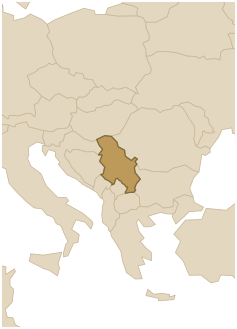
Serbia lies at the heart of the Balkans, in southeastern Europe, with no coastline. It is a crossroads, where Central Europe meets the Mediterranean world and the East, on the great routes that have always linked the West to Constantinople. About 6.5 million people live there; the capital, Belgrade, one of the oldest cities in Europe, stands where the Sava meets the Danube.
Geography
The country falls into two parts. North of the Danube, the great river that crosses the country and flows past Belgrade, lies the rich, flat, fertile plain of Vojvodina, an extension of the great Hungarian plain. To the south and west the land rises into wooded mountains and hills, cut by gorges and dotted with hot springs and old monasteries. It is a green farming country known for its plum orchards and raspberries.
Peoples and history
The Serbs are a Slavic people who settled in the Balkans in the early Middle Ages. They founded a powerful kingdom and then an empire, at its height in the 14th century under Tsar Dušan, and built many monasteries. In 1389 the battle of Kosovo Polje against the Ottomans opened a long period of Turkish rule; it remains at the heart of national memory. Serbia was reborn in the 19th century and became the core of Yugoslavia, which united the South Slavs in the 20th century. Its break-up in the 1990s brought deadly wars and mass atrocities; Kosovo, whose 2008 declaration of independence Serbia does not recognise, remains an open question.
Language and religion
Serbian is a South Slavic language, very close to Croatian and Bosnian, unusual in being written in both the Cyrillic and Latin alphabets. The country is deeply attached to the Serbian Orthodox Church, whose medieval monasteries and frescoes are symbols of a national identity kept alive through centuries of foreign rule.
Culture and way of life
Music is everywhere in Serbia, especially the brass of the Balkan brass bands, celebrated at the big Guča festival, and the kolo, a circle dance on UNESCO's intangible heritage list. At the table people share grilled meat, ćevapi, with rakija, homemade plum brandy and a sign of hospitality. The Serbian people gave the world the inventor Nikola Tesla, born in what is now Croatia, and the tennis champion Novak Djokovic.