Timor-Leste
A young mountain nation on an island between Asia and Oceania, Catholic and Portuguese-speaking, born of a long and bloody struggle for freedom.
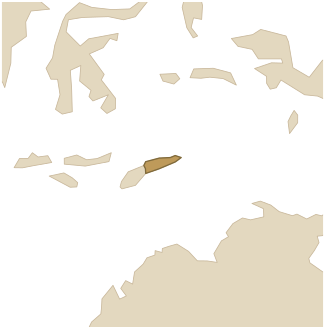
At a glance
Timor-Leste occupies the eastern half of the island of Timor, where Southeast Asia meets Oceania, close to Australia. It is one of the youngest countries in the world: it gained full independence only in 2002, after one of the longest and deadliest liberation struggles of the late 20th century. About 1.4 million people live there; the capital is Dili. A former Portuguese colony, hence its Portuguese language and Catholic faith in a mostly Muslim region, it keeps an identity forged in resistance. In 2025 it became the eleventh member of ASEAN, the Association of Southeast Asian Nations.
Geography
Timor-Leste is a country of steep mountains dropping to the sea: a backbone of forested peaks, deep valleys and hilltop villages runs through the centre of the island. The coasts have beaches, mangroves and some of the richest coral reefs in the world, in the waters of the "Coral Triangle", where whales and dolphins pass. The tropical climate has a dry season and a rainy season. The country also has an exclave, Oecusse, surrounded by the Indonesian part of the island.
History
Long prized for its sandalwood, the island was colonised by Portugal, which held its eastern half for four centuries. In 1975 Timor declared independence but was immediately invaded and annexed by neighbouring Indonesia. Twenty-four years of extremely brutal occupation followed: according to the country's truth commission, it caused up to 180,000 deaths. The resistance, led by figures such as Xanana Gusmão and José Ramos-Horta, winner of the 1996 Nobel Peace Prize, never gave up. In 1999 an overwhelming referendum vote for independence set off terrible violence, until an international intervention led to the country's official birth in 2002.
Languages and faith
The country has two official languages: Tetum, a local Austronesian language that became the common tongue, and Portuguese, readopted after independence as a mark of identity against Indonesia; many local languages and Indonesian are also spoken. With the Philippines, Timor-Leste is one of the two majority-Catholic countries in Asia: a Portuguese legacy that grew stronger under occupation, when the Church was a pillar of the resistance. This faith coexists with old beliefs, the lulik, the sacredness of the ancestors and the land.
Culture and way of life
Timorese culture blends Austronesian, Portuguese and Catholic worlds. Tais, a traditional hand-woven cloth with patterns particular to each region, is worn at ceremonies and given as a sign of respect. The sacred houses, the uma lulik, keep the objects and spirits of the ancestors and are at the centre of clan life, with their dances and rituals. Life revolves around maize, rice, the sea and the well-regarded mountain coffee.