Afghanistan
A mountain country in the middle of Asia, on the Silk Roads, a land of poets and horsemen that many empires crossed but none held for long.
At a glance
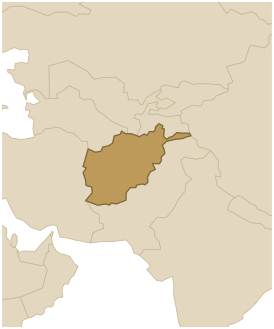
Afghanistan is a landlocked country walled in by mountains, where Central Asia, the Iranian plateau and the Indian subcontinent meet. The Silk Roads and the great migrations passed through it, and so did the armies of nearly every conqueror in history, which made it a major crossroads. None of them held this land of mountain peoples for long, hence its nickname, "the graveyard of empires". About 41 million people live there, and the capital is Kabul.
Geography
The Hindu Kush, a name often translated as "Hindu killer", cuts across the middle of the country with snow-capped peaks and hard passes. On either side lie fertile valleys, where snowmelt waters the fields and well-known orchards, and beyond them dry plateaus and deserts to the south and west. In the north-east, a narrow strip of land, the Wakhan Corridor, runs to China between some of the highest mountains on earth. It is a high country with a harsh climate.
History
Great civilisations grew on this land. It was Bactria, a rich province of the Persian Empire, then a Greek kingdom after Alexander the Great came through. In the first millennium it was a major centre of Buddhism: the giant Buddhas of Bamiyan were carved into the cliff in the 6th century. Islam took hold gradually, above all from the 10th century, and the city of Herat became a great centre of Persian culture. In the 19th century Afghanistan was the prize in the "Great Game" between the British and Russian empires, and later the scene of long wars.
Peoples, languages and faith
Afghanistan has many peoples: the Pashtuns, the largest group, in the south and east; the Persian-speaking Tajiks in the north and in the cities; the Hazaras of the central mountains; and the Uzbeks and Turkmens of the north. Two main languages are spoken: Dari, a form of Persian and the language of culture and poetry, and Pashto. The country is almost entirely Muslim, mostly Sunni, with a large Shia minority among the Hazaras. Among the Pashtuns, a code of honour and hospitality, the Pashtunwali, governs much of social life.
Culture and way of life
Afghanistan is a land of poetry: classical Persian poetry is at home here, and Rumi, by tradition, was born in Balkh. The national sport, buzkashi, in which riders fight over a carcass, comes from the horse peoples of the steppes. Hand-knotted Afghan carpets are sought after all over the world. At the table, the national dish, kabuli pulao (rice with carrots, raisins and lamb), is shared with guests, whom custom treats as sacred.