Angola
A large Portuguese-speaking country in Southern Africa, on the Atlantic, rich in oil and diamonds, whose rhythms, carried to Brazil by the slave trade, are among the roots of samba.
+ Umbundu, Kimbundu, Kikongo…
At a glance
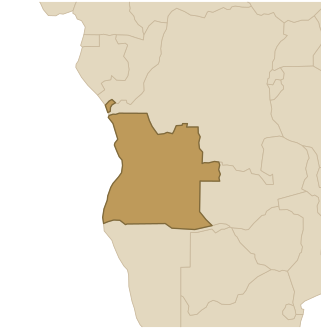
Angola is a large country in Southern Africa with a long Atlantic coastline. After Brazil, it has the largest population of any Portuguese-speaking country, the legacy of five centuries of Portuguese presence. About 35 million people live there, many of them in the capital, Luanda, on the ocean, now one of the largest Portuguese-speaking cities in the world. Rich in oil and diamonds, Angola is still recovering from a long war.
Geography
From the ocean, the land rises inland in steps. A dry coastal plain runs along the Atlantic, with the Namib Desert reaching up from the south. Beyond it the land climbs to a high inland plateau, cooler and wetter, which is where most Angolans live and farm, covered in savanna and crossed by many rivers. In the north the vegetation grows denser and more tropical toward the Congo Basin. From the southern sands to the northern forests, the country still has wide open spaces and wildlife.
Peoples and history
Before the Europeans arrived, the region had powerful Bantu kingdoms, such as Kongo and Ndongo, whose royal title, ngola, gave the country its name. Queen Nzinga held off the Portuguese there for decades. For centuries Angola was the main source of the slave trade to Brazil, which is why the two sides of the Atlantic share such close ties of blood and culture. A Portuguese colony until 1975, the country then went through a long civil war that ended in 2002.
Languages and religion
Portuguese is the official language and, more and more, the first language of city dwellers, but many Bantu languages are spoken too, such as Umbundu, the language of the Ovimbundu, the largest ethnic group, as well as Kimbundu and Kikongo. The great majority of Angolans are Christian, Catholic or Protestant, often alongside traditional beliefs and respect for the ancestors.
Culture and way of life
Some of the world's most danced music comes from Angola. Angolan rhythms carried to Brazil by the slave trade are among the roots of samba, and Angola's own semba is a close cousin. Kizomba, a sensual partner dance now danced on every continent, was born here, followed by the more energetic kuduro. Some of the roots of capoeira are also traced to Angola. The food is built on cassava, fish and beans, with funge, a cassava porridge.