Åland Islands
An autonomous, Swedish-speaking archipelago in the Baltic, between Sweden and Finland: thousands of islands, a demilitarised territory and a Nordic identity of its own.
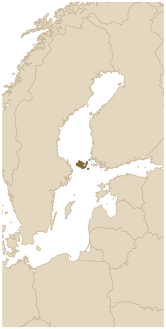
more than 6,700 islands and islets
At a glance
The Åland Islands are an autonomous archipelago in the Baltic Sea, at the mouth of the Gulf of Bothnia, halfway between Sweden and Finland. They belong to Finland but have a special status: they are Swedish-speaking, largely self-governing, demilitarised and neutral, with their own flag and parliament. About 30,000 people live there, in the capital, Mariehamn, and on a few of the archipelago's thousands of islands and islets. Swedish in language and culture, Ålanders have kept a separate identity, protected by an international status found nowhere else.
Geography
Åland has more than 6,700 islands and islets, only a handful of them inhabited, scattered across the Baltic. The landscape is typically Nordic: low islands of pink granite smoothed by glaciers, pine and birch forest, meadows and fields, and a sea dotted with rocks and skerries. The main island holds most of the people and the farmland. Water is everywhere, calm and good for sailing. The climate is cool, with mild, bright summers and winters when the sea sometimes freezes.
History
Settled since prehistoric times, the islands were long part of the kingdom of Sweden, which explains their language and culture. In 1809 they passed under Russian rule along with the rest of Finland. When Finland became independent in 1917, the Swedish-speaking Ålanders overwhelmingly wanted to join Sweden. The League of Nations settled the matter in 1921: the islands would stay Finnish, but with wide autonomy, a guarantee for the Swedish language, and demilitarisation. The compromise, often cited as a model of peaceful settlement, has held for a century.
Language and faith
Swedish is the archipelago's only official language, and the autonomy exists precisely to protect it within a mostly Finnish-speaking Finland. Ålanders are traditionally Lutheran Christians, like the rest of the Nordic world, and the Evangelical Lutheran Church is bound up with the history of every community. The old medieval stone churches spread across the islands are among the archipelago's finest monuments. Society today, though, is largely secular, as elsewhere in Scandinavia.
Culture and way of life
Åland culture is Nordic and maritime, Swedish in language and shaped by the archipelago and the sea. Sailing has a long history here: in the age of the great sailing ships, Åland had a large fleet, and Mariehamn still has a maritime museum and the four-masted Pommern. The Nordic summer has its festivals, including Midsommar with its ribboned pole, and life goes on in red wooden houses by the water or in stugor (summer cabins). The food is Baltic and Scandinavian: fish (herring, salmon), Åland black bread, dark and sweet, and the Åland pancake served with jam and cream.