Albania
A mountain country on the Adriatic that sees itself as heir to the ancient Illyrians, long the most closed country in Europe and now open again.
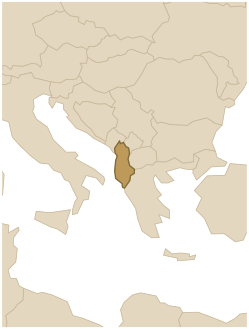
At a glance
Albania is a small mountainous country in the Balkans, on the Adriatic and Ionian seas, facing Italy, which can be seen on a clear day. Albanians call their country Shqipëria, a name often linked to their word for "eagle", and a black eagle sits on their flag. Fewer than three million people live in the country, around the capital, Tirana, but almost as many Albanians live outside its borders, in Kosovo and in the diaspora. Long the most isolated and secretive state in Europe, Albania has opened up again.
Geography
Three-quarters of Albania is mountains: in the north, the wild, steep "Albanian Alps" and their remote valleys; in the centre and east, high ranges and lakes, including Lake Ohrid, one of the oldest in the world. Along the sea, the "Albanian Riviera" has beaches and turquoise coves that tourism long ignored. Fertile plains lie between the mountains and the coast. The mountains are still rugged, and wildlife there is very rich.
History
Albanians see themselves as heirs to the Illyrians, an ancient people of the western Balkans, which would make them one of the oldest peoples in the region. In the 15th century the national hero Skanderbeg held off the Ottoman Empire for a quarter of a century; the country then spent more than four centuries under Ottoman rule, and part of the population converted to Islam. Independent from 1912, Albania lived after the war under one of the harshest and most isolated communist dictatorships in the world, that of Enver Hoxha, who cut the country off from everything and covered it with more than 100,000 bunkers. The regime fell in 1991.
Language and faith
Albanian forms a branch of the Indo-European family on its own, with no close relative among living languages. Several religions coexist peacefully: a Muslim majority, a legacy of Ottoman times, alongside Orthodox and Catholic Christians. The communist regime made Albania the world's first officially atheist state; faith has returned, with a tolerance often held up as an example.
Culture and way of life
Albanian culture is shaped by an old code of honour, the besa: a promise that must never be broken, which once obliged people to protect a guest even at the risk of their own life. This is how Albanians saved many people fleeing persecution. There are the polyphonic songs of the south, on UNESCO's intangible heritage list, embroidered costumes, and the stone tower houses of the north. Guests are welcomed readily, coffee is shared at all hours, and the food is Mediterranean and Balkan: lamb, vegetables, filled pastries (byrek), cheese and olives.