Andorra
A small Pyrenean principality between France and Spain, whose system of government goes back to feudal Europe.
+ Spanish, French
At a glance
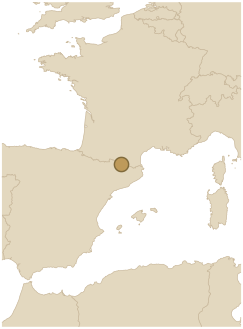
Andorra is a tiny landlocked principality in the Pyrenees, between France and Spain, and entirely mountainous. About 80,000 people live there, around the capital, Andorra la Vella, the highest capital in Europe. Its system of government is unique: it is a co-principality whose two heads of state are today the President of France and the Bishop of Urgell in Spain, heirs to a feudal agreement more than seven centuries old. A country of mountains, skiing and duty-free shopping, Andorra is prosperous and has long held on to its independence and neutrality.
Geography
Andorra is a high mountain country lying entirely in the Pyrenees: peaks that often top 2,500 metres, deep valleys fanning out, glacial lakes, forests and high pastures. Streams run down from the snowy summits, and villages of stone and slate cling to the slopes. The Madriu valley, still wild, is a World Heritage Site. In winter Andorra is one of the main ski areas of the Pyrenees; in summer people come to hike.
History
According to tradition, Andorra began with a charter from Charlemagne, rewarding its people for their help against the Moors. Its system of government dates from 1278: to settle a dispute, the Count of Foix (whose rights later passed to the kings of France and then to the Republic) and the Bishop of Urgell agreed to rule the territory jointly, under an agreement called a "pareatge". This medieval co-principality has stayed almost unchanged for seven centuries, which makes Andorra one of the oldest states in Europe. The country adopted a democratic constitution in 1993 and kept its two princes.
Language and faith
The official language is Catalan: Andorra is the only country in the world where it is the sole official language. Spanish, French and Portuguese are also widely spoken, since the population comes from many countries. The country is traditionally Catholic, to the point that a bishop is one of its two princes. Its small stone Romanesque churches, scattered through the valleys, are among the finest examples of Pyrenean Romanesque art.
Culture and way of life
Andorran culture belongs to the Pyrenean valleys and the Catalan world, shaped by the mountains and a long autonomy. It has its Romanesque churches and their frescoes, its traditional dances, the contrapàs and the ball pla, and its village festivals, the festes majors. People hike, ski and take the thermal waters. The local cooking mixes Catalan and French influences: trinxat (cabbage and potato), grilled meats, charcuterie and mountain cheese.