United Arab Emirates
A federation of seven emirates on the Persian Gulf, a land of desert and oil that became a global hub of trade and luxury within a generation, from the pearl divers of old to the towers of Dubai.
about 90% of them foreign nationals
+ English widely spoken
At a glance
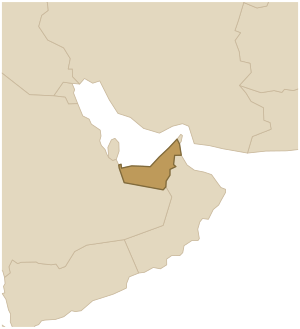
The United Arab Emirates is a young federation of seven emirates, including Abu Dhabi, the capital, and Dubai, the best known, on the southern shore of the Persian Gulf in the Arabian Peninsula. In barely two generations, this land of desert and fishing villages has become one of the richest hubs in the world, first through oil and then through huge development projects: skyscrapers, artificial islands, giant airports. Unusually, Emiratis make up only about one resident in ten: the country runs on a vast population of expatriates and workers from Asia, the Arab world and the West. It is a federal monarchy.
Geography
The Emirates is above all a desert country. Inland begins the Rub' al-Khali, the "Empty Quarter", one of the largest sand deserts in the world, with red dunes and oases such as Al Ain. In the north-east, the bare Hajar mountains run down toward the Gulf of Oman. Life has always gathered on the Persian Gulf coast, with its warm water and mangroves, once the domain of pearl divers and sailors and now lined with new cities. The climate is scorching and very dry, with summers among the hottest on the planet.
History
For centuries, life on this coast belonged to the desert Bedouin and the pearl divers of the Gulf, whose trade kept a few small ports modestly prosperous. In the 19th century these emirates came under British protection and were known as the "Trucial States". Everything changed with the discovery of oil in the late 1950s. In 1971, as the British left, six emirates, soon seven, united to form the United Arab Emirates, led by Sheikh Zayed, their founding father. Within a generation, oil money transformed the desert: roads, schools, hospitals, glass towers. Dubai, which bet on trade, tourism and finance more than on oil, became the symbol of this transformation.
Language and faith
The official language is Arabic, spoken here in a Gulf dialect; but with a mostly foreign population, English is the language of daily life and business, alongside Urdu, Hindi, Tagalog and many others. Sunni Islam is the state religion and shapes daily life, the calendar and the law; the great Sheikh Zayed Mosque in Abu Dhabi is its best-known monument. Unusually for the region, the Emirates allows a degree of religious tolerance, with churches and temples for its many foreign residents, while holding on to Islamic values and local customs.
Culture and way of life
Emirati culture combines the Bedouin and Arab traditions of the Gulf with a cosmopolitan way of life. At the foot of the skyscrapers, the desert heritage is still there: falconry, the sport of princes, camel and Arabian horse racing, nabati poetry, dhows, cardamom coffee and hospitality. Dubai has the tallest tower in the world and giant shopping malls. The majlis, the reception room where people talk and make decisions, is still the centre of social life. Fragrant Arab cooking, with machbous (spiced rice with meat), dates and coffee, sits alongside food from all over the world.