Argentina
The great country of the far south, from the peaks of the Andes to the ice of Patagonia, a land of vast plains settled by waves of European immigrants.
8th largest in the world
with a strong Italian lilt
At a glance
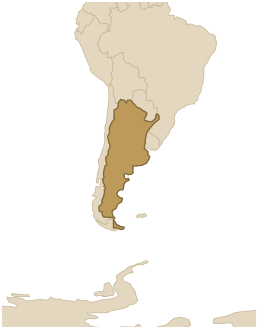
Argentina covers most of the Southern Cone of South America, the long triangle that stretches toward Antarctica. It is the eighth-largest country in the world, yet thinly populated: most of its 46 million people live around the huge capital, Buenos Aires, one of the great cities of Latin America. More than any other country in the region, Argentina was populated by great waves of European immigration.
Geography
The country brings together landscapes that could not be more different. In the west rises the long wall of the Andes, with Aconcagua, the highest peak in the Americas. In the centre lies the Pampa, a vast fertile grassland where cattle graze and wheat grows, and where Argentina's wealth began. In the north are the Iguazú Falls and subtropical lands; in the far south, Patagonia, a huge windswept steppe edged with glaciers and fjords, all the way to Tierra del Fuego.
Peoples and history
Before the conquest the land was home to indigenous peoples, the Guaraní in the north, the Mapuche and others in the south. Spain colonised the region, long a backwater of its empire, until independence in 1816. Modern Argentina, though, was mostly made by mass immigration: between 1870 and 1930, millions of Europeans, above all Italians and Spaniards, but also Germans, Jews and Arabs, landed in Buenos Aires, drawn by the farmland of the Pampa. Within a few decades the country was one of the richest in the world. In the 20th century, politics was dominated by Perón and his wife Evita, idolised by a large part of the population.
Language and religion
Argentine Spanish is instantly recognisable: sing-song, with an Italian lilt inherited from the immigrants, and its own expressions, the famous "che" and vos instead of "tú". The country is traditionally Catholic (it gave the Church its first Latin American pope, Francis, born in Buenos Aires), although fewer people practise today and other faiths have their place.
Culture and way of life
Argentina means tango first of all, the wistful music and dance born in the poor districts of Buenos Aires and now known all over the world. It means a passion for football, the football of Maradona and Messi. It means the gaucho, the horseman of the plains, and the asado, long barbecues of meat shared with friends over a glass of Malbec. And it means maté, a bitter herbal drink passed from hand to hand among friends.