Armenia
An old mountain country in the Caucasus, the first nation to adopt Christianity, the land of Mount Ararat and stone monasteries, whose people mostly live abroad.
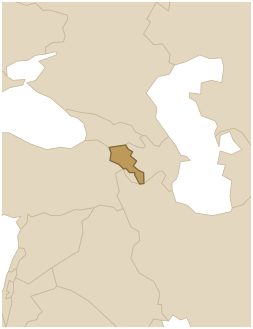
At a glance
Armenia is a small landlocked mountain country in the Caucasus, between Europe and Asia. It is one of the oldest centres of civilisation in the world and the first nation to make Christianity its state religion, more than seventeen centuries ago. About three million people live in the country, around the capital, Yerevan, but far more Armenians live in the diaspora, scattered across the world by a tragic history. It is a land of high plateaus, monasteries and pink stone.
Geography
Armenia is a high, entirely mountainous country: a volcanic plateau folded into ranges and deep valleys, with a harsh climate. In the middle lies Lake Sevan, one of the largest high-altitude lakes in the world. Yet the country's symbol stands outside its borders: Mount Ararat, the biblical volcano where Noah's Ark is said to have come to rest, looms snow-capped over Yerevan but now lies in Turkey, which Armenians feel as a loss. Everywhere, a pink volcanic stone, tuff, gives towns and churches their particular colour.
History
Armenia is heir to kingdoms nearly three thousand years old, among them Urartu. In 301 it became the first state in the world to adopt Christianity, almost a century before Rome, which shaped its identity for good. Long squeezed between the Persian, Byzantine, Ottoman and Russian empires, it suffered in 1915 the genocide carried out by the Ottoman Empire: more than a million Armenians killed or deported, the wound behind the scattering of the people. After being a Soviet republic, Armenia regained its independence in 1991, and has since been marked by the conflict over Nagorno-Karabakh.
Language and faith
Armenian forms a very old branch of the Indo-European family on its own, with no close relative among living languages. It has its own alphabet, created in 405 by the monk Mesrop Mashtots to translate the Scriptures into the people's language: one of the few alphabets invented from scratch. Armenia is inseparable from its Apostolic Church, the oldest national church in the world, whose stone monasteries, often perched on steep sites, are central to Armenian identity.
Culture and way of life
Armenian culture is a culture of stone. There are the khachkars, steles finely carved with crosses and interlacing, numbering in the thousands, no two alike. There is the low, mournful sound of the duduk, a flute made of apricot wood and listed by UNESCO as intangible heritage. There are illuminated manuscripts and the well-known brandy, and the food centres on lavash (a large flatbread), grilled meat, dolma and the apricot, the national fruit.