Australia
A country the size of a continent, at the far end of the world, a red land of bush and of the oldest living cultures on earth, now home to people from everywhere.
largest city: Sydney
6th largest country
At a glance
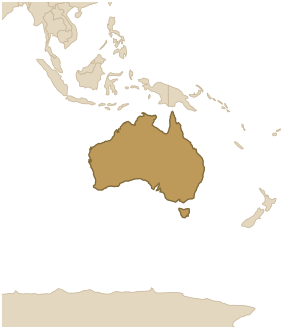
Australia is a country the size of a continent, surrounded by ocean, at the far edge of Oceania. The sixth-largest country in the world, it is still thinly populated: most of its 26 million people live along the coasts, in cities such as Sydney and Melbourne, while the vast interior, the bush and the outback, is almost empty. It is a young, prosperous nation of immigrants from all over the world, and also home to the oldest living human cultures, those of the Aboriginal peoples, who have been here for more than sixty thousand years.
Geography
The outback takes up most of the country: a vast, dry, red interior of deserts, plains and plateaus, with the sacred rock of Uluru at its centre. Life is concentrated on the milder coasts, with their long beaches, and in the forests and mountains of the east. Offshore lies the Great Barrier Reef, the largest reef in the world, visible from space. Cut off for millions of years, Australia has wildlife found nowhere else: kangaroos, koalas, platypuses.
History
The first Aboriginal people reached Australia more than sixty thousand years ago, after one of the oldest sea crossings in human history, and developed hundreds of cultures and languages there. Dutch navigators sailed along its coasts in the 17th century, but it was James Cook who claimed the east coast for Britain in 1770. In 1788 the British founded a penal colony there: colonisation was a catastrophe for the first inhabitants, who were driven from their land and decimated. The colonies federated in 1901. Long closed to non-white immigrants, Australia opened up after the war to immigration from all over the world, and is moving, with difficulty, toward recognition of its first peoples.
Languages and faith
The country's language is English, with an accent and slang all its own. Before it there were hundreds of Aboriginal languages, among the oldest in the world; a few dozen survive, and efforts are under way to save them. Immigration has brought languages from everywhere. Australia is Christian by tradition but very secular. Aboriginal spirituality, with the "Dreaming" (Dreamtime), the sacred story of creation that binds land, ancestors and living beings together, is among the oldest worldviews of humankind.
Culture and way of life
Australian culture combines a very old Aboriginal heritage with a modern, relaxed, multicultural society. There is Aboriginal art, with its dot paintings and Dreaming stories, and the deep drone of the didgeridoo, a very old instrument. There is the spirit of the bush, a love of the beach, surfing, sport and the outdoors, the barbecue with friends and an easygoing loyalty known as mateship. The food has become cosmopolitan, drawing on Asia and Europe.