Azerbaijan
The "land of fire" on the Caspian, between Europe and Asia: a land of oil, carpets and ancient fire temples.
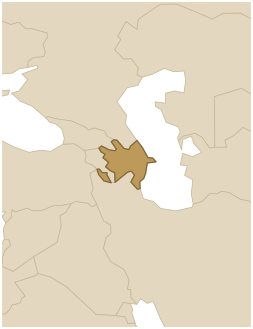
At a glance
Azerbaijan is a country in the Caucasus, between Eastern Europe and Western Asia, on the Caspian Sea, the largest enclosed body of water in the world. It is nicknamed the "land of fire": since ancient times, flames have burst naturally from its gas-rich ground, and oil made the fortune of the capital, Baku. Ten million people live there, mostly Azerbaijanis, a Turkic-speaking Muslim people whose history mixes Persian, Russian and Caucasian influences.
Geography
The country is framed by the Greater Caucasus to the north and the Lesser Caucasus to the west, with snowy peaks and isolated villages. Between them lies a large central plain, hot and dry, crossed by the Kura River. To the east the land drops toward the Caspian and the Absheron Peninsula, covered in derricks and refineries around Baku. Azerbaijan has the largest concentration of mud volcanoes in the world, and hillsides where natural gas fires burn without stopping. To the south-west, cut off from the rest of the country by Armenia, lies a mountainous exclave, Nakhchivan.
History
An ancient land of Zoroastrianism, the Persian religion of sacred fire, whose temples can still be visited, the region came under Persian, Arab and then Turkic influence, and took up Islam and a Turkic language. In the 19th century the Russian Empire annexed it, and Baku had one of the first great oil booms in history, drawing investors from all over the world. In 1918 Azerbaijan proclaimed the first democratic, secular republic in the Muslim world, where women got the vote before those of many European countries; it was then absorbed into the USSR. Independent since 1991, the country has been deeply marked by the Nagorno-Karabakh conflict with neighbouring Armenia.
Language and faith
Azerbaijani is a Turkic language, very close to the Turkish of Turkey, and is now written in the Latin alphabet. The country is mostly Muslim, and one of the few with a Shia majority. Yet society is very secular, a legacy of the 1918 republic and the Soviet decades: religion is low-key, and the long-established Christian and Jewish minorities are tolerated.
Culture and way of life
Azerbaijani culture mixes Persian, Turkic and Caucasian influences. There is mugham, a modal classical singing style with long, melancholy vocal lines, on UNESCO's intangible heritage list, and the ashik, the bard who accompanies himself on the lute. There is the art of the carpet, woven in regional patterns passed down for centuries. There is the old town of Baku, with medieval lanes at the foot of ultramodern glass towers. At the table there is plov, saffron rice in endless variations, kebabs, fresh herbs, and tea served in small pear-shaped glasses with jam.