Benin
The birthplace of Vodun and of the old kingdom of Dahomey, a narrow West African country on the Gulf of Guinea.
seat of government: Cotonou
+ French
At a glance
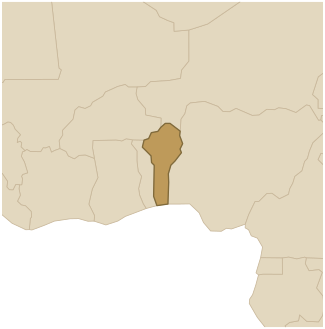
Benin is a long, narrow country in West Africa, stretching from the Gulf of Guinea in the south to the savannas of the north. Thirteen million people live there, from many different peoples, including the Fon and the Yoruba in the south. The official capital is Porto-Novo, but the largest city and economic centre is Cotonou, on the coast. Small as it is, Benin has a long history: it was the cradle of a powerful kingdom and of the Vodun religion.
Geography
The hot, humid south opens onto the Gulf of Guinea through a strip of beaches, lagoons and palm groves; on Lake Nokoué stands Ganvié, a village built on stilts and nicknamed "the Venice of Africa". Further north, the forest gives way to savanna and then to drier plateaus, with large parks for elephants and lions such as Pendjari. Rivers and hills cross the country all the way from the ocean to the edge of the Sahel.
History
Benin was the heart of the powerful kingdom of Dahomey, a centralised warrior state famous for its army of women soldiers, whom Europeans called the "Amazons", and for its capital, Abomey. This coast also bore a terrible name, the "Slave Coast": over two centuries, more than a million captives were shipped from it to the Americas, many of them from Ouidah. Their descendants in the Caribbean and Brazil still keep that memory and culture. Colonised by France, the country became independent in 1960 and, after a Marxist period, was one of the first in Africa to return peacefully to democracy, in 1990.
Languages and faith
Benin has many languages: Fon and Yoruba in the south, Bariba and Dendi in the north, among many others; French, inherited from colonisation, is the common language. The country is the birthplace of Vodun (voodoo), a traditional religion that honours a pantheon of deities and the spirits of the ancestors. Here it is officially recognised and celebrated, far from the clichés, and the slave trade carried it to Haiti, Cuba and Brazil. Christianity and Islam are also widespread, often living comfortably alongside the ancestral religions.
Culture and way of life
First there is the memory of the kings of Abomey, their palaces, bas-reliefs and thrones, some of which, long held in France, have come back to the country. There is the world of Vodun, with its ceremonies, masks and festivals, such as the outings of the Egungun, costumed spirits who embody the ancestors. Benin's rhythms travelled to the Americas with the slave trade. At the table there are sauces, cassava, pounded yam and maize.