Bonaire
A small Dutch island in the southern Caribbean, a land of salt, flamingos and reefs, a special municipality of the Netherlands with a mixed population that speaks Papiamento.
At a glance
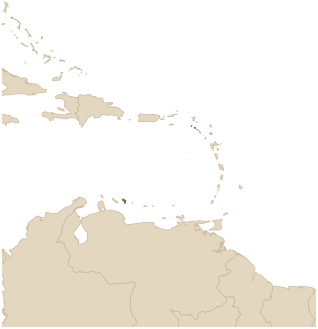
Bonaire is a small island in the southern Caribbean, the easternmost of the Dutch "ABC islands" (Aruba, Bonaire, Curaçao), off Venezuela. Since 2010 it has no longer depended on Curaçao: it is a special municipality directly attached to the Netherlands. About 20,000 people live there, around the small main town, Kralendijk. Quiet, dry and thinly populated, the island is known worldwide for diving and for its nature: reefs, flamingos and salt flats. Its mixed population speaks Papiamento.
Geography
Bonaire is a low, dry island with a desert climate cooled by the trade winds, outside the hurricane belt. Cactus, divi-divi trees and acacias cover flat land, with a few hills in the north. In the south lie large salt flats with pink water, worked for centuries, where colonies of flamingos gather. All around, the water is crystal clear and a coral reef circles the island; protected as a marine park, it is one of the finest diving areas on the planet, together with the islet of Klein Bonaire.
History
Home to the Caquetío Amerindians, Bonaire was occupied by the Spanish and taken by the Dutch in 1636. The Dutch built no large plantations there, but worked the salt flats, gruelling labour forced on enslaved Africans; the tiny stone huts where they slept still stand facing the salt pans. Goat herding and salt gave the island a modest living for a long time. After abolition, the mixed population went on living from the land and the sea. In 2010, when the Netherlands Antilles were dissolved, Bonaire chose a direct link with the Netherlands and became a special municipality of the kingdom.
Language and faith
Bonaireans speak Papiamento, the creole of the ABC islands, Iberian-based with Dutch and African elements, as well as Dutch, the official language. The island is mostly Catholic, with Protestant communities. Saints' days and local traditions mark the rhythm of life in this small community.
Culture and way of life
Bonairean culture is Caribbean and mixed, and close to nature. Music and dance follow Afro-Caribbean rhythms, such as the simadan, a harvest festival dating from the days of sorghum farming, with its songs and drums; the carnival is very colourful. The slave huts and salt pans recall the island's history. Life moves slowly, facing the sea, and diving plays a big part in it. Creole cooking is built on fish and goat, with kabritu stobá (goat stew) and funchi, a cornmeal polenta.