Burkina Faso
The "land of upright people", in the heart of the Sahel, home of the Mossi kingdoms and capital of African cinema.
+ Mooré, Dioula… (~60 languages)
At a glance
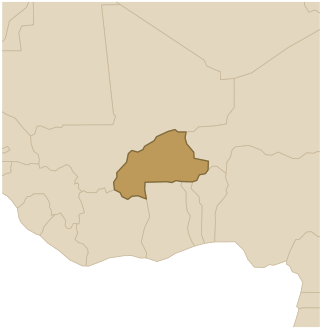
Burkina Faso is a landlocked country in the middle of West Africa, in the Sahel, the transition zone between the Sahara and the savannas. Its name, chosen in 1984, combines two of its languages and means "land of upright people". It was given by the young revolutionary president Thomas Sankara, who is admired across Africa. Twenty-two million people, among the youngest populations in the world, live there, around the capital, Ouagadougou. The country is poor in resources, but its cultural life is known across the continent.
Geography
The country is a vast, flat, dry plateau with a Sahelian climate: a long, scorching dry season swept by a sand-laden wind, the harmattan, then a short rainy season that turns the savanna green again. The north, on the edge of the desert, is the driest; the slightly wetter south allows farming and herding. Three rivers cross it, the Black, White and Red Volta, which gave the country its old name of "Upper Volta". It is a harsh land, where people have learned to live with little water.
Peoples and history
The heart of the country is the Mossi world, whose kingdoms, founded centuries ago around the Mogho Naba, the Mossi "emperor", held out against the great empires of the Sahel and still carry prestige today. Many other peoples live alongside them: Fulani herders, Bobo, Gourmantché, Lobi. France made the territory the colony of Upper Volta, which became independent in 1960. In the 1980s, Thomas Sankara's short-lived revolution renamed the country and made it a symbol of African pride; Sankara was assassinated in 1987.
Languages and religion
Some sixty languages are spoken in Burkina Faso; the most widespread is Mooré, the language of the Mossi, Dioula is used for trade, and French, inherited from colonisation, is the official language. The country was long held up as an example of religious coexistence: a Muslim majority, a large Christian minority and very active African traditional religions live side by side, often within the same family. The jihadist violence that has hit the country since the mid-2010s has put this balance under severe strain.
Culture and way of life
Poor as it is, Burkina Faso has an intense cultural life. Ouagadougou hosts FESPACO, the largest festival of African cinema, which has made the city a capital of the continent's film-making. Its crafts are well known: lost-wax bronzes, masks, sculpture and weaving. Drums and the balafon liven up every celebration. The sense of community and mutual help is strong, and Sankara's memory is still very present.