Bangladesh
The country of the largest delta in the world, a land of water, rice and poetry, and one of the most densely populated nations on earth.
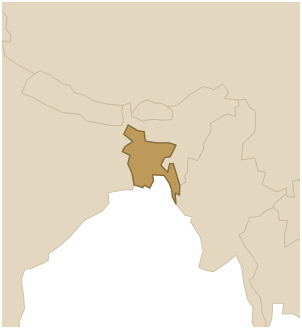
8th most populous country
At a glance
Bangladesh sits on the largest delta on the planet, where the Ganges and the Brahmaputra, coming down from the Himalayas, meet before flowing into the Bay of Bengal. It is a country of water, flat, green and crossed by countless rivers. Some 170 million people live on this fertile land, making it one of the most densely populated countries in the world; the capital, Dhaka, is enormous. The Bengali language and culture hold the country together.
Geography
Almost the whole country is a vast delta plain, barely above sea level, criss-crossed by rivers, channels and rice paddies. The silt makes the land very fertile but also very exposed: every year the monsoon and the cyclones of the Bay of Bengal bring floods that people have learned to live with. In the south lie the Sundarbans, the largest mangrove forest in the world and home of the Bengal tiger; only the far south-east has a few hills.
Peoples and history
Bengal has always been one of the richest and most populous regions of the subcontinent, famous for its cotton cloth, its scholars and its poets. Long Hindu and Buddhist, it became largely Muslim under the sultans and then the Mughals. Its wealth drew the British, who made it the centre of their Indian empire. When they left in 1947, Bengal was split in two: its Muslim eastern half became East Pakistan. Cut off from the rest of Pakistan by the whole of India, and by language, the Bengalis rose up; after a terrible war of liberation, they proclaimed their own country in 1971: Bangladesh, "the land of Bengal".
Language and religion
Bengali is central to the country's identity, so much so that the nation was born partly out of a struggle for the language. It is an old Indo-European language, one of the most widely spoken in the world, with a vast literature: the poet Rabindranath Tagore, the first non-European to win the Nobel Prize, is its great figure, and one of his songs is the national anthem. Bangladesh is overwhelmingly Sunni Muslim, with an Islam often coloured by Sufism and local traditions, and a large Hindu minority.
Culture and way of life
Bengali culture is steeped in literature and music: people love poetry and song, including the mystical songs of the Bauls, wandering minstrels. Life revolves around water and boats, and every meal is built on rice and fish; the hilsa fish is the national dish. The streets are full of painted rickshaws.