Bulgaria
An old Balkan country on the Black Sea, birthplace of the Cyrillic alphabet and of the Damask rose, between Europe and the East.
since 2026
At a glance
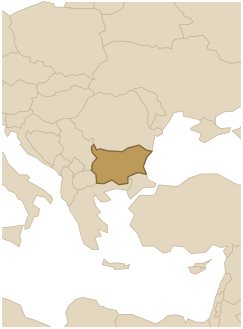
Bulgaria is a Balkan country in south-eastern Europe, with the Black Sea to the east and the Danube along its northern border. It is said to be one of the oldest states in Europe: founded in the 7th century, it has never changed its name. About 6.5 million people live there, around the capital, Sofia, at the foot of Mount Vitosha. A country of mountains, rose fields and beaches, between Christian Europe and the Ottoman East, Bulgaria gave the Slavic world its alphabet.
Geography
Mountains cross the country: the Balkan range (Stara Planina), which cuts it from west to east, and, in the south-west, the high Rila and Pirin ranges, with alpine peaks and glacial lakes. Fertile plains lie between them, including the famous Valley of the Roses, where Damask roses are grown for their precious oil. To the east, the Black Sea coast is lined with sandy beaches and resorts; to the north, the Danube marks the border.
History
This land first belonged to the Thracians, an ancient people of skilled goldsmiths and the legendary homeland of Orpheus and of the gladiator Spartacus. In the 7th century the Bulgars, horsemen from the steppes, joined the Slavs already living there to found a powerful empire. It was in Bulgaria that the disciples of Cyril and Methodius created the Cyrillic alphabet in the 9th century, used today from Russia to Serbia. After a medieval golden age, the country spent nearly five centuries under Ottoman rule, was reborn in the 19th century, and lived under communism until 1989.
Language and faith
Bulgarian is a South Slavic language; its early form was the first Slavic language to be written, in the Cyrillic alphabet born on this soil. Bulgaria is Orthodox Christian by tradition, with an old national church whose monasteries, such as Rila in the mountains, are among the country's great sites of religious art. Nearly five centuries of Ottoman presence left a Muslim minority and an Eastern imprint.
Culture and way of life
Bulgaria is known all over the world for its polyphonic singing by women's voices, with startling harmonies: one of these songs is even travelling aboard the Voyager probes, at the edge of the solar system. There is Thracian gold, the art of icons, and the horo circle dances. There is also yoghurt, whose bacterium is named after the country, the rose and its perfume, wine, and food built on vegetables, white cheese (sirene) and grilled meat. One detail confuses visitors: here, nodding means "no" and shaking the head means "yes".