Bahrain
A small archipelago in the Persian Gulf, the land of ancient Dilmun and of pearls, one of the oldest seafaring crossroads in the Gulf.
At a glance
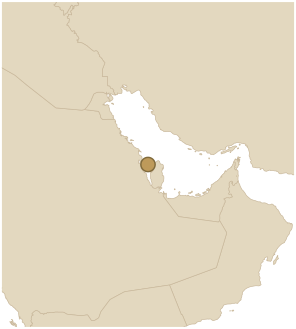
Bahrain is a small archipelago in the Persian Gulf, linked to Saudi Arabia by a long causeway. Its name means "the two seas", and it is the smallest Arab state. One and a half million people live there, many of them foreigners, around the capital, Manama. More than four thousand years ago these islands were the heart of the ancient civilisation of Dilmun, one of the oldest trading hubs in the world. Long a great centre of pearl diving, Bahrain was also the first Arab country in the Gulf to strike oil, and today presents itself as one of the most open in the region.
Geography
Bahrain is a low, desert archipelago of some thirty islands, the largest of which shares the country's name. The climate is hot and humid. Unusually for this dry region, the island has freshwater springs, some of them rising under the sea: together with its palm groves, they gave it a reputation as a garden and an oasis, and fed the legend of paradise. The coast, where divers once gathered the pearl oysters that gave the finest pearls in the Gulf, is now lined with artificial islands and the towers of Manama. In the desert of the interior stands the lone "Tree of Life", several centuries old.
History
Bahrain has one of the oldest histories in the Gulf: the islands were the heart of Dilmun, a prosperous Bronze Age civilisation and a major stop between Mesopotamia and the Indus Valley, as vast fields of burial mounds still show. Known for their pearls since ancient times, the islands were coveted and ruled in turn by the Persians, the Portuguese and, since the late 18th century, the Al Khalifa dynasty, which still reigns. In 1932 Bahrain became the first Arab country in the Gulf to discover oil, which gave it a head start. Independent since 1971, it has become a financial centre for the region.
Language and faith
Bahrainis speak Arabic, in a Gulf dialect, but English and the languages of the many foreign residents are everywhere. The country is mostly Muslim, with a feature that has shaped its history: most of the population is Shia, while the ruling dynasty is Sunni. Bahrain also stands out for a degree of religious openness: it has churches, a Hindu temple and one of the oldest Jewish communities in the peninsula, a legacy of its long past as a trading hub.
Culture and way of life
Bahraini culture keeps the memory of its pearling and seafaring past: dhows, the divers' songs (fidjeri), and the sites of the pearling trail, listed as World Heritage. Its crafts are old: pottery, weaving, traditional boat-building. Social life centres on the majlis, the reception room where people talk over cardamom coffee and dates. Bahrain is seen as one of the most relaxed countries in the Gulf, with a lively cultural and restaurant scene. Meals feature fish, spiced rice (machboos) and sweets.