The Bahamas
An archipelago of seven hundred islands in turquoise water between Florida and the Caribbean, the first land Columbus reached in the New World, whose people are mostly of African descent.
+ Bahamian Creole
At a glance
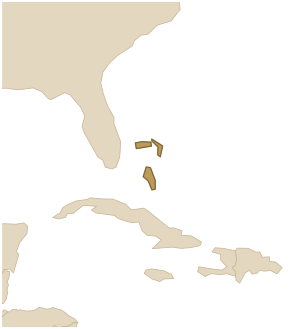
The Bahamas are a huge archipelago in the Atlantic, on the edge of the Caribbean, off Florida and Cuba: more than seven hundred islands and thousands of cays and reefs, scattered over hundreds of kilometres of very blue sea. Only about thirty are inhabited, and most of the 400,000 Bahamians live around the capital, Nassau. Famous worldwide for their white and pink sand beaches and clear water, the Bahamas live from tourism and finance. Most of the population is of African descent, and it was on one of these islands that Columbus first made landfall in the Americas.
Geography
The Bahamas are an archipelago of coral and limestone, with low, flat islands and no mountains or rivers. Their wealth is their water: very clear turquoise shallows, lagoons, reefs and blue holes, deep underwater sinkholes. Some beaches have pink sand. You can swim with sharks, rays and even, on one deserted beach, pigs. The climate is tropical and sunny, but the islands lie in the path of Atlantic hurricanes.
History
It was here, on 12 October 1492, that Christopher Columbus first made landfall in the Americas, on an island he named San Salvador. Its inhabitants, the Lucayans, were wiped out within a few decades. Almost empty for a long time, the islands became a notorious pirate haven in the 17th and 18th centuries: Blackbeard ruled there. The British then set up plantations worked by enslaved Africans, whose descendants make up most of the population. In the 19th century the islands also took in Africans freed from slave ships. The Bahamas have been independent since 1973.
Language and faith
The official language is English, spoken day to day as a musical, colourful Bahamian Creole. The Bahamas are said to have one of the highest numbers of churches per head in the world: Baptist, Anglican, Catholic, faith is everywhere and sets the rhythm of social life. In the background, spiritual traditions of African origin, obeah, survive from the days of slavery.
Culture and way of life
Bahamian culture is Afro-Caribbean. Its great festival is Junkanoo, a street parade held before dawn on Boxing Day and New Year's Day: crepe-paper costumes, cowbells, whistles and goatskin drums, to rhythms inherited from Africa. There is rake and scrape music, played with a carpenter's saw, plaited straw work, and the sea everywhere. The food features conch (a large sea snail served in salads or fried), fish, peas and rice, and tropical fruit.