Bosnia and Herzegovina
A mountain country in the middle of the Balkans, between East and West, home of the Mostar bridge and of several peoples and faiths.
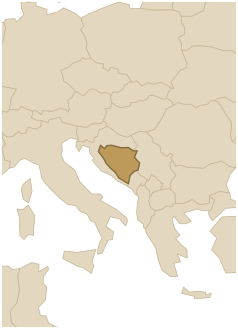
At a glance
Bosnia and Herzegovina is a mountain country in the middle of the Balkans, almost landlocked, with a tiny strip of Adriatic coast. About three million people live there, divided among three peoples with shared roots but different histories: the Bosniaks (Muslim), the Serbs (Orthodox) and the Croats (Catholic). Its capital, Sarajevo, where mosques, churches and a synagogue stand side by side, was long a model of coexistence before it endured a long siege during the war of the 1990s.
Geography
The country is very mountainous: the Dinaric Alps cover it with wooded slopes, gorges, emerald rivers and peaks that hosted the 1984 Winter Olympics. To the north lies Bosnia, with its hills; to the south, Herzegovina, drier and Mediterranean, a land of vineyards and white stone, where the Neretva flows under the famous bridge of Mostar. The country has many springs and waterfalls, and some of the last primeval forests in Europe.
History
An independent medieval kingdom, Bosnia was conquered in 1463 by the Ottomans, who ruled it for more than four centuries; part of the population converted to Islam, which is the origin of the Bosniak people. Taken over by Austria-Hungary, it entered world history in 1914, when the Sarajevo assassination set off the First World War. As a republic of Yugoslavia, it fell, when Yugoslavia broke up, into a horrific war (1992–1995), marked by the siege of Sarajevo and the Srebrenica genocide. The Dayton Accords ended it and created today's complex federal state, which is slowly rebuilding.
Languages and religions
Bosnians speak one South Slavic language, called Bosnian, Croatian or Serbian depending on the community: very close variants, written in the Latin or Cyrillic alphabet. The country stands out for its religious diversity: Sunni Islam, from the Ottoman era, Orthodox Christianity and Catholicism live side by side, and a Sephardic Jewish community lived there for centuries. This coexistence earned Sarajevo the nickname "Jerusalem of Europe".
Culture and way of life
Bosnian culture links East and West. There is old Ottoman Sarajevo, its bazaar (the Baščaršija), its mosques and the smell of coffee, brewed in a copper pot and served in small cups. There is the bridge of Mostar, an Ottoman masterpiece rebuilt after the war, from which divers leap into the river. There is the sevdalinka, a traditional melancholy love song, and copperwork and carpets. Favourite foods are ćevapi (small grilled sausages) and flaky burek.