Belarus
A country of forests and marshes in Eastern Europe, "White Russia", a land scarred by war that still has great primeval forests.
At a glance
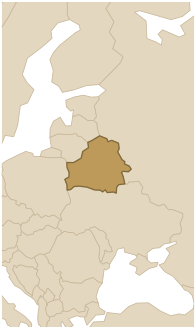
Belarus is a landlocked country in Eastern Europe, between Russia, Ukraine, Poland and the Baltic states. Its old name means "White Russia"; it is a flat land of forests, marshes and slow rivers. A little over nine million people live there, around the capital, Minsk, which was completely rebuilt after being razed in the Second World War. Long at the crossroads of the Russian, Polish and Lithuanian worlds, Belarus has stayed, more than its neighbours, in Russia's orbit.
Geography
Belarus is a country of gentle plains, one of the flattest in Europe, covered in vast forests and wetlands. It has the Białowieża Forest, one of the last remnants of the great primeval forest that once covered Europe, where European bison, saved from extinction, still roam free. The country has thousands of lakes, marshes (the Pripet Marshes) and many rivers. These forests and marshes long served as a refuge, and as a battlefield.
History
A land of the early East Slavs, Belarus was in the Middle Ages one of the centres of the Grand Duchy of Lithuania, and later of the Polish-Lithuanian Commonwealth: this is when it formed its language and culture, before being absorbed by the Russian Empire. The 20th century was terrible: part of the USSR, it suffered Nazi occupation and was one of the hardest-hit countries of the war, losing about one person in four and seeing hundreds of villages wiped out. Independent since 1991, it is ruled with an iron hand and remains the European country closest to Moscow.
Language and faith
The country has two official languages: Belarusian, an East Slavic language close to Russian and Ukrainian, and Russian, which dominates everyday life and the cities. Belarusian, long the language of the countryside, remains a symbol of national identity. Most Belarusians are Orthodox Christian by tradition, with a large Catholic minority in the west, a legacy of the country's long shared past with Poland and Lithuania.
Culture and way of life
Belarusian culture is rooted in an old world of farms and forests. There are the Slavic festivals that go back to pagan times, such as Kupala Night at the summer solstice, with bonfires, flower wreaths floated down the river and the search for the fern flower. There are linen and woven straw crafts, embroidery with red geometric patterns, and icons. In the kitchen, the potato comes in countless forms, including draniki, grated potato pancakes, alongside black bread, borscht and mushrooms picked in the forest.