Bolivia
The highest country in South America, at the centre of the Andean world, home of the great salt flat and of the sacred lake of the Incas.
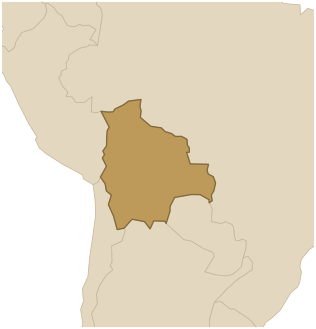
seat of government: La Paz
At a glance
Bolivia is a landlocked country in South America, and the most Andean of all: highland culture, that of the Aymara and Quechua, heirs to the great Andean civilisations, is more present here than anywhere else. The country has two capitals: Sucre, the constitutional capital, and La Paz, the seat of government and the highest capital in the world, at over 3,600 metres. Twelve million people live between the icy altiplano, the valleys and the hot Amazon lowlands. Bolivia is proud of its indigenous roots, and it long remained poor despite huge mineral wealth.
Geography
The west of the country is taken up by the altiplano, a huge, cold high plateau between two ranges of the Andes, swept by wind at nearly four thousand metres. Here are Lake Titicaca, the highest large navigable lake in the world and, in legend, the birthplace of the Incas, and the Uyuni salt flat, a vast expanse of salt that turns into a giant mirror after rain. To the east, the land drops to temperate valleys (the yungas), then to wide tropical plains and the Amazon forest, which actually cover more than half the country.
History
Long before the Incas, the great civilisation of Tiwanaku flourished on the altiplano near Lake Titicaca. The region was absorbed into the Inca empire and fell with it to the Spanish, who found at Potosí the richest silver mountain in the world: it paid for the Spanish Empire for centuries, at the cost of hundreds of thousands of indigenous and African workers' lives. The country became independent in 1825 and took its name from the liberator Simón Bolívar. Having lost its coastline in a war with Chile, Bolivia went through a turbulent history up to the election in 2006 of Evo Morales, the first president from the indigenous peoples.
Languages and faith
Bolivia recognises many official languages: Spanish, and above all Quechua and Aymara, the languages of the great Andean peoples, spoken by millions; its indigenous share of the population is one of the highest in the Americas. The country defines itself as plurinational. Most people are Catholic, but their Catholicism is mixed with Andean beliefs: the Pachamama, Mother Earth, receives offerings at every stage of life, from sowing seed to setting off on a journey.
Culture and way of life
Bolivia is one of the great centres of Andean culture. You see Aymara women with long braids, full skirts (polleras) and bowler hats, brightly coloured weaving, and you hear pan pipes and charangos. There are the great festivals, such as the carnival of Oruro and its Diablada, a dance of masked devils, on UNESCO's intangible heritage list. People eat potatoes, of which the Andes have hundreds of varieties, maize and quinoa, and have chewed coca leaves for thousands of years against altitude sickness.