Brazil
The giant of South America, a country the size of a continent, born of the mixing of three worlds (Indigenous, European and African) and covered by the largest forest on earth.
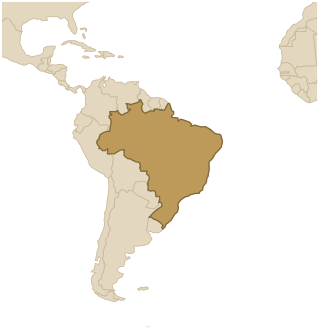
largest city: São Paulo
5th largest in the world
largest Portuguese-speaking country
At a glance
Brazil is a country the size of a continent: it covers almost half of South America and borders nearly every other country on it. With about 215 million people, it is the giant of the region and the largest Portuguese-speaking country in the world. It is a young, mixed nation, born of the meeting of three worlds, and known for its festivals, music and football. Its largest city is São Paulo; its capital, Brasília, was built from scratch in the middle of the country in the late 1950s.
Geography
Two great regions dominate the country. In the north lies the immense basin of the Amazon, the largest river in the world by volume, surrounded by the largest rainforest on the planet, with unmatched biodiversity. In the south and east are high plateaus and a long Atlantic coast lined with beaches, where the big cities are, such as Rio de Janeiro and its bay. Between the two lie vast savannas, the cerrado, now one of the world's great farming regions.
Peoples and history
Before 1500, the land was home to hundreds of Indigenous peoples. Then came the Portuguese, who made it a colony of sugar, then of gold. To work these riches, they brought an enormous number of slaves from Africa: Brazil was the main destination of the Atlantic slave trade, receiving nearly five million Africans, more than anywhere else, and it was the last country in the Americas to abolish slavery, in 1888. From this painful history came a deeply mixed people, who combine Indigenous, European and African heritage and have made it their identity.
Language and religion
Brazil is the only country in the Americas where people speak Portuguese, a Portuguese of its own, musical and full of Indigenous and African words. It still has more Catholics than any other country in the world, although evangelical churches are growing fast. But its most original spirituality comes from Africa: Afro-Brazilian religions such as candomblé kept alive, hidden behind the names of saints, the Yoruba gods brought by the slaves, and they shape the country's music, dance and festivals.
Culture and way of life
Brazilian culture means samba and bossa nova, the music of "The Girl from Ipanema"; it means the carnival of Rio, one of the biggest festivals in the world; it means capoeira, a martial art danced to music, created by enslaved Africans. It also means a passion for football: Brazil has won the World Cup five times. The food is made for sharing, from feijoada, a slow-cooked black bean stew, to barbecued meat.