Barbados
A small coral island at the far eastern edge of the Caribbean, the birthplace of rum and home of Rihanna, whose people are mostly of African descent and long very English in style.
+ Bajan Creole
At a glance
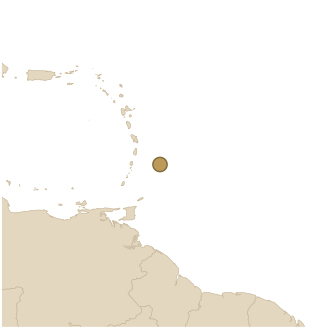
Barbados is a small island in the Caribbean, the easternmost of them all, alone in the Atlantic and set apart from the arc of the Antilles. Fewer than 300,000 people live there, around the capital, Bridgetown. The great majority of Barbadians, or "Bajans", are of African descent, with a culture so shaped by the long British presence that the island was nicknamed "Little England". Prosperous and stable, known for its beaches and its rum, Barbados became a republic in 2021, leaving the British monarchy behind.
Geography
Unlike its volcanic neighbours, Barbados is an island of coral and limestone, fairly flat, with no high mountains. Its coasts have two faces: to the west and south, on the Caribbean Sea, white-sand beaches and calm turquoise water; to the east, on the Atlantic, a wild coast pounded by the swell and loved by surfers. The rolling interior is covered in fields of sugar cane, which once made the island rich. Beneath the limestone lie some fine caves. The climate is tropical, cooled by the trade winds, and the island sits on the edge of the hurricane belt.
History
Once home to Amerindians and later abandoned, the island was colonised by the English in 1627 and became one of the first and most profitable sugar colonies in the Americas. Its wealth rested on the enslavement of hundreds of thousands of Africans, the ancestors of almost all Barbadians. Barbados stayed British without a break for more than three centuries, hence its strong English heritage. After slavery was abolished in 1834, and a long struggle for equality, it became independent in 1966, then a republic in 2021, cutting its tie to the British Crown.
Language and faith
The official language is English, but day to day Barbadians speak Bajan, a creole born of English and African languages, with an instantly recognisable sing-song accent. Barbados is strongly Christian, with a solid Anglican tradition from British times alongside other churches, and the island is dotted with places of worship. Faith plays a big part in social life, with traditions of African origin in the background.
Culture and way of life
Barbadian culture is Afro-Caribbean with a very British polish. Its big event is Crop Over, a summer festival that grew out of the celebrations at the end of the sugar harvest and ends in a carnival of costumes, calypso and soca. The island gave the world a star, Rihanna, now a national hero. Barbados is also the birthplace of rum: some of the very first was distilled here, nearly four centuries ago. Cricket, inherited from England, is a passion. The national dish is flying fish with cou-cou, made of cornmeal and okra.