Brunei
A small, very wealthy sultanate on the island of Borneo, a land of primeval forest and golden mosques, and what remains of a powerful maritime empire.
+ English
At a glance
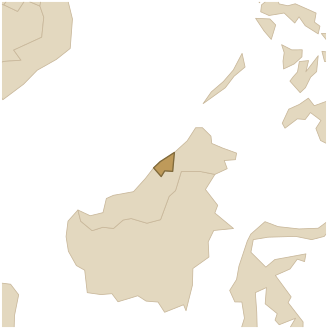
Brunei is a small sultanate in Southeast Asia, on the north coast of the island of Borneo, surrounded on land by Malaysia. Small as it is, it is one of the richest countries in the world thanks to its oil and gas, which give its roughly 450,000 people a very high standard of living with no income tax. It is also one of the last absolute sultanates on the planet, ruled by one of the oldest reigning dynasties in the world. Heir to a once-powerful maritime empire, Brunei combines oil wealth, a devoutly practised Islam and large primeval forests.
Geography
Most of Brunei is covered in primeval rainforest, among the best preserved in Southeast Asia: thanks to oil, the country never had to clear its forest for palm oil, and it protects large areas of it, home to proboscis monkeys, hornbills and a great variety of life. The coast, on the South China Sea, alternates between beaches and mangroves. In the capital, Kampong Ayer, a huge stilt village on the river, inhabited for centuries, is nicknamed the "Venice of the East". The climate is equatorial, hot and humid.
History
In the 15th and 16th centuries, the sultanate of Brunei was a great power: its maritime empire covered much of Borneo and reached as far as the Philippines, living from the trade in spices and forest products. Converted to Islam, it reached its height and then declined as Europeans and pirates moved in. Reduced to a small territory, it placed itself under British protection. The discovery of oil in 1929 made it rich. Fully independent since 1984, Brunei has kept its absolute monarchy and an official ideology, "Malay Islamic Monarchy".
Language and faith
The official language is Malay; English is widely spoken, as are the languages of Borneo's indigenous peoples. Brunei is a Sunni Muslim country: Islam is the state religion and a pillar of national identity, and the country applies a strict version of Islamic law. The capital's mosques, with golden domes reflected in the water, are among the most beautiful in Southeast Asia. Buddhist and Christian minorities, mostly of Chinese origin, live alongside the Muslim majority.
Culture and way of life
Bruneian culture belongs to the Malay and Muslim world. There is the protocol and pageantry of the sultan's court, and the craft of weaving with gold thread (jong sarat), and of working silver and brass. Life centres on the mosque and the family, with respect for elders and custom. In Kampong Ayer, houses on the water linked by walkways keep alive a way of life several centuries old. Malay cooking is built on rice, fish and fragrant curries; the national dish is ambuyat, a sago paste.