Bhutan
A small Buddhist kingdom high in the Himalayas, the "land of the thunder dragon", which measures its success by the happiness of its people.
At a glance
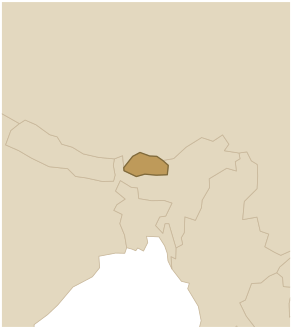
Bhutan is a small landlocked kingdom in the Himalayas, between India and China. The Bhutanese call it Druk Yul, the "land of the thunder dragon". It is one of the most isolated countries in the world: long closed to foreigners, it only allowed television and the internet in 1999. Fewer than a million people live there, around the capital, Thimphu. Bhutan is known for an idea of its own: it judges its success by "Gross National Happiness", which makes well-being, culture and nature goals of policy alongside wealth.
Geography
Bhutan is a country of very high mountains, from the hot, subtropical south to the snowy peaks of the Himalayas in the north, which rise above seven thousand metres; out of respect for the gods, mountaineering is banned, and the highest of them has never been climbed. In between, deep green valleys hold villages, terraced rice fields and monasteries. More than 70% of the country is forest, protected by the constitution, home to tigers, snow leopards and the takin, the national animal. It is one of the few countries in the world that absorbs more carbon than it emits.
History
Bhutan was shaped by Buddhism, brought in the 8th century, so the story goes, by the master Padmasambhava, who is said to have flown on the back of a tigress to the site of the Tiger's Nest, a monastery clinging to a cliff. In the 17th century a religious leader, the Zhabdrung, unified the country and gave it its fortress-monasteries, the dzongs. A monarchy was founded in 1907. It was the kings themselves who led the move to democracy: in 2008 the absolute monarchy became a constitutional one. Bhutan has always chosen to protect its identity and its natural environment over development at any cost.
Language and faith
The official language is Dzongkha, a Tibeto-Burman language close to Tibetan and written in a script derived from it, alongside many local languages. Bhutan is one of the last countries of Tibetan Buddhist tradition (of the Vajrayana school), which its constitution calls the country's "spiritual heritage"; this Buddhism shapes architecture, art, the calendar, daily life and politics. Prayer flags, prayer wheels, monks in maroon robes and dzongs are everywhere in the landscape.
Culture and way of life
Bhutan guards its culture closely. Traditional dress is compulsory in government offices, schools and official places: the gho, a wrap-around robe belted at the waist for men, and the kira for women. Traditional buildings, put up without a single nail and decorated with bright frescoes, follow ancient rules. The great religious festivals, the tshechu, bring villages together for masked dances that tell the Buddha's teachings. Archery, the national sport, is played amid much cheerful noise. The national dish is ema datshi, chillies in cheese, and very hot.