Botswana
The country of the Kalahari and of a great delta in the middle of the desert, a land of elephants and of some of the oldest peoples on earth, known for its stability.
+ English
At a glance
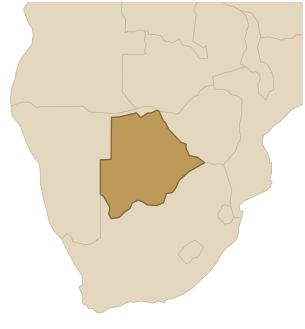
Botswana is a landlocked country in Southern Africa, as large as France but with just under two and a half million people, which makes it one of the least densely populated countries in the world. Much of it is covered by the Kalahari desert. Around the capital, Gaborone, and its largest people, the Tswana, the country has built a strong reputation: it is one of the oldest democracies in Africa, and long one of the continent's most prosperous and stable economies, thanks largely to well-managed diamonds.
Geography
The Kalahari, a desert of sand and scrub, covers most of the country. Botswana also has the Okavango Delta, where a great river, instead of reaching the sea, spreads out and vanishes into the sand, creating a huge maze of channels, islands and lagoons in the middle of the desert, teeming with wildlife. In the north, along the Chobe River, live the largest concentrations of elephants on the planet. Elsewhere lie the great Makgadikgadi salt pans, old dried-up lakes, almost perfectly flat.
History
The Kalahari has been home for tens of thousands of years to the San (Bushmen), hunter-gatherers who are among the oldest peoples in the world. Later came the Tswana, Bantu herders organised into kingdoms. Under threat in the 19th century, their chiefs themselves asked Britain for protection, and the country became the protectorate of Bechuanaland. At independence in 1966, Botswana was one of the poorest countries in the world; the discovery of diamonds, together with honest, democratic government, rare on the continent, turned it into a success story within a few decades.
Languages and faith
The national language is Setswana, the Bantu language of the Tswana, spoken by the great majority and a force for unity; English is the official and administrative language. In the desert, the San still speak click languages. Botswana is mostly Christian, and faith sits alongside botho, an African ethic of dignity, respect and shared humanity that shapes social life and the way the country is governed.
Culture and way of life
The culture of Botswana gives great weight to consensus and dialogue, inherited from the kgotla, the village assembly where anyone may speak and decisions are made together, under a tree. There is the ancient knowledge of the San, who know the desert better than anyone; the woven baskets of the Okavango, famous worldwide; songs and dances. Cattle, a sign of wealth and status, matter a great deal, and the national dish is seswaa, pounded meat served with maize or sorghum porridge.