Canada
A huge country in North America, the second largest in the world, a land of forests, lakes and snow, peopled by immigration on the lands of Indigenous peoples who have lived there for thousands of years.
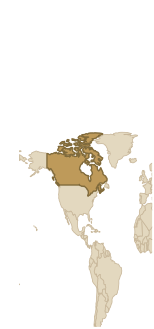
2nd largest country in the world
At a glance
Canada is the second-largest country in the world after Russia, stretching from sea to sea, from the Atlantic to the Pacific, and up to the Arctic. Yet it is thinly populated, with about forty million people, most of whom live in a narrow band along the border with the United States; the Far North is almost empty. It is a nation of immigration, born of the meeting between Indigenous peoples (First Nations, Inuit and Métis) and settlers from France and then Britain, joined today by immigrants from all over the world. Officially bilingual in English and French, wealthy and committed to multiculturalism, Canada is a federation of ten provinces and three territories.
Geography
Canada is above all vast spaces and nature. An endless boreal forest, the taiga, runs across it from coast to coast; it has more lakes than any other country and a huge share of the planet's fresh water. In the west rise the Rocky Mountains; in the east lie the Maritime provinces and the St. Lawrence River, the country's historic backbone; in the middle, the great wheat plains of the Prairies. To the north is the Arctic, a land of tundra, ice, polar bears and long nights, home of the Inuit. Winter, long and hard, shapes the country and the way people live.
History
Long before the Europeans, the land had been home for thousands of years to Indigenous peoples, from the First Nations of the forests and plains to the Inuit of the Arctic. In the 17th century the French founded New France along the St. Lawrence, with Quebec City in 1608: a society of settlers, fur traders and missionaries. In 1763, after the Seven Years' War, France ceded Canada to Britain, and the two founding peoples, French-speaking and English-speaking, had to learn to live together. In 1867 the union of the colonies created the Canadian Confederation. The country spread from sea to sea and took in successive waves of immigrants. Today it is seeking reconciliation with Indigenous peoples, who were long oppressed.
Languages and faith
Canada is officially bilingual: English, the majority language, and French, the language of more than one Canadian in five, most of them in Quebec, where it is central to the province's identity. Add to this dozens of Indigenous languages and, in the big cities, languages from all over the world brought by immigration. The country is Christian by tradition, Catholic, especially among French speakers, and Protestant among English speakers, but today it is very secular and diverse, and religious freedom is one of its founding values.
Culture and way of life
Canadian culture mixes British and French heritage, Indigenous traditions and influences from all over the world, with a way of life turned toward nature. It is the land of ice hockey, a national passion, of maple syrup and wide open spaces, of Quebec's singer-songwriters. There is First Nations art and its totem poles, festivals and outdoor life: canoeing, snowmobiling, sugar shacks. The food ranges from Quebec's poutine to smoked salmon and tourtière. Canadians have made diversity part of who they are.