Switzerland
The water tower of Europe, a country of the Alps, neutrality and four languages, known for peace, precision and direct democracy.
+ Romansh
At a glance
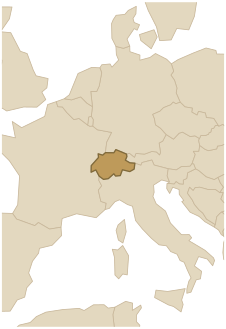
Switzerland is a small, landlocked mountain country in the middle of Europe, between Germany, France, Italy and Austria. Its position and terrain have made it a country apart: a neutral country that stayed out of its neighbours' wars and became prosperous and stable. Switzerland holds together without a shared language or religion: four languages and several faiths coexist in a confederation of cantons, one of the oldest democracies in the world. About nine million people live there; the capital is Bern.
Geography
Switzerland is the water tower of Europe: several of the continent's great rivers, including the Rhine and the Rhône, flow down from its mountains. The Alps, with peaks such as the Matterhorn, their glaciers and deep blue lakes, cover much of the country. Between the Alps in the south and the Jura in the north-west lies the Plateau, a region of hills, lakes and towns where most people live. The landscape is one of pastures, chalets and hilltop villages, all very carefully kept.
Peoples and history
According to tradition, Switzerland was born in 1291, when three mountain valleys swore an oath to defend their freedoms together; legend places William Tell in the same period. Around this core, the Confederation grew little by little, canton by canton. Known for their courage, the Swiss were long the most sought-after mercenaries in Europe, and the Pope's Swiss Guard is their heir. After centuries of religious tension between Catholic and Protestant cantons, Switzerland had its neutrality recognised in 1815 and set up a modern federal state in 1848. The Red Cross was founded in Geneva.
Languages and religion
Switzerland has four national languages, by region: German, spoken by the majority in dialects of its own, French in the west, Italian in the south, and Romansh, a Latin language spoken by a small minority in the mountains of Graubünden. This sharing of languages is central to Swiss identity. The country has both Catholic and Protestant traditions, Calvin's Reformation having spread out from Geneva, but nearly a third of the population now says it has no religion.
Culture and way of life
Switzerland is a byword for precision and quality: its watchmaking is an art, its banks an institution, and "Swiss" has come to mean reliable. People love the mountains, skiing and hiking, and melted cheese dishes, fondue and raclette, shared with friends. Swiss chocolate is among the finest in the world.