Chile
The longest of countries, a narrow strip of land between the Andes and the Pacific, from the driest desert in the world to the ice of Patagonia.
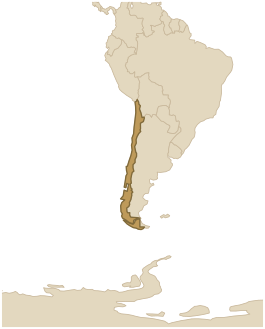
more than 4,300 km long
At a glance
Chile has a unique shape: a strip of land more than four thousand kilometres long but less than two hundred wide on average, between the wall of the Andes to the east and the Pacific Ocean to the west. It runs from the northern deserts to the very tip of the continent, close to Antarctica, and this length gives it almost every climate on earth. Nineteen million people live there, most of them in the temperate Central Valley, around the capital, Santiago, which sits at the foot of the snowy cordillera.
Geography
From north to south, the country runs from one extreme to the other. In the far north lies the Atacama Desert, the driest in the world, where it can go years without rain; its very clear sky draws astronomers from everywhere. In the centre, a fertile valley with a Mediterranean climate is covered in vineyards and orchards. Further south come rain and cold: temperate rainforest, lakes and volcanoes, then the land breaks up into the fjords, glaciers and islands of Patagonia. Far out in the Pacific, Chile also owns Easter Island and its giant statues.
Peoples and history
Before the conquest, several peoples lived in Chile; the best known, the Mapuche, held out against the Inca empire and then the Spanish for centuries, an almost unique case in the Americas. Spanish colonisation produced, as elsewhere, a largely mestizo population. Independent from 1818, the country built its wealth on copper, of which it is the world's largest producer. In the 20th century it won two Nobel Prizes in literature, but also went through the 1973 coup and General Pinochet's dictatorship, before democracy returned in 1990.
Language and religion
Chilean Spanish is instantly recognisable: fast and colourful, with words from Mapudungun, the language of the Mapuche, still spoken in the south. The country is Catholic by tradition, a faith brought by Spain that is very present in festivals and popular culture, although society has become much more secular and has a growing number of evangelicals and people with no religion.
Culture and way of life
Chile is called a "country of poets": it has given the world two Nobel laureates in literature, Pablo Neruda and Gabriela Mistral, and poetry matters a great deal there. Its national dance is the cueca, and Víctor Jara's committed "new song" is still much loved. People share empanadas and seafood from a coast rich in fish, and drink the wine of the valleys or pisco. The Andes and Patagonia keep Chileans close to nature.