China
One of the oldest continuous civilisations in the world, a vast country that gave the world paper, printing, the compass and gunpowder.
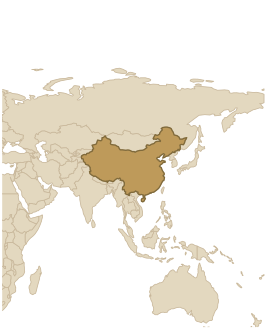
largest city: Shanghai
nearly one person in six
3rd–4th largest in the world
+ many regional languages
At a glance
China is a vast country, about the size of all of Europe, and one of the two most populous countries in the world, with around 1.4 billion people. It is also one of the oldest continuous civilisations in human history: a culture, a script and a state handed down without a break for more than three thousand years. Its capital is Beijing; its largest city, Shanghai.
Geography
The land steps down like a staircase from west to east. In the far west rise the highest mountains in the world, the Himalayas and the high Tibetan Plateau, followed by the Gobi and Taklamakan deserts. The land then drops to the great eastern plains, where most people live, watered by two great rivers: the Yellow River in the north, cradle of Chinese civilisation, and the Yangtze in the south, the longest river in Asia. From the bitter cold of Manchuria to the tropical rice fields of the south, China has almost every climate.
History
Chinese history is counted in dynasties. In 221 BCE the first emperor, Qin Shi Huang, unified the country by force, standardised the script and had the first Great Walls joined up; his tomb is guarded by an army of thousands of terracotta soldiers. Then came great golden ages: the Han, who gave their name to the majority people; the Tang and the Song, times of refinement and invention; the Ming and their Forbidden City. China gave the world paper, printing, the compass and gunpowder. The two-thousand-year-old empire collapsed in 1912; after decades of war, the People's Republic was proclaimed in 1949.
Language and writing
What we call "Chinese" is really a family of languages, some as far apart as French and Spanish: Mandarin in the north, Cantonese in the south, and many more. They share a single script: thousands of characters that record words and meanings more than sounds, so that two Chinese people who cannot understand each other's speech can read each other's writing. More than three thousand years old, it is the oldest writing system still in use, and calligraphy is still regarded as a major art.
Beliefs
Chinese thought grew around three great traditions that complement each other. Confucianism set the rules for society, the family and respect for elders; Taoism sought harmony with the natural course of things, the Tao; Buddhism, which came from India, brought its temples and its inner search. The same person could follow all three at different times of life. Honouring the ancestors remains central to family life.
Culture and way of life
Chinese food, one of the richest cuisines in the world, changes completely from one region to another (Peking duck, the fiery dishes of Sichuan, Cantonese dim sum) and is shared around a round table. China is also the land of tea, silk and porcelain (still called "china" in English), of herbal medicine and acupuncture. For the great Lunar New Year festival, hundreds of millions of people travel home: it is the largest annual human migration on the planet.