Cameroon
Nicknamed "Africa in miniature" because it brings together almost every face of the continent, a country at the meeting point of West and Central Africa.
largest city: Douala
+ ~250 languages
At a glance
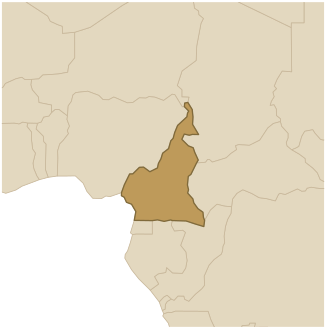
Cameroon is nicknamed "Africa in miniature": it has almost every landscape on the continent, from the desert of the north to the equatorial forests of the south, from beaches to volcanic highlands. It is also a human crossroads between West and Central Africa, home to some 250 peoples. The country is officially bilingual, in French and English, because of its colonial history. About 28 million people live there, between the capital, Yaoundé, and the great port of Douala.
Geography
From south to north, the country sums up Africa. In the south lies dense, hot, humid equatorial forest. Further up come plateaus and volcanic highlands, dominated by Mount Cameroon, an active volcano and the highest peak in West and Central Africa, whose foot runs down into the sea. Further north, the forest gives way to savanna, then to dry steppe reaching Lake Chad and the edge of the Sahel.
Peoples and history
The Cameroon region holds a major place in African history: it was from the border area between Cameroon and Nigeria that the great Bantu expansion probably set out several thousand years ago, the movement of farming peoples that would settle the southern half of the continent. Kingdoms later flourished here, such as that of the Bamum, whose king Njoya even invented a script. A German colony, Cameroon was split between France and Britain after the First World War, hence its two languages, before being reunited at independence in 1960–1961. Since 2016, the English-speaking regions in the west have been torn by armed conflict.
Languages and religion
Cameroon is one of the most multilingual countries in the world, with around 250 languages. French and English, both official, serve as common languages depending on the region, alongside very lively local languages. The south and west are mostly Christian, the north largely Muslim, and traditional religions are still present everywhere.
Culture and way of life
Cameroon gave African music one of its great styles, makossa: Manu Dibango's "Soul Makossa" went round the world and inspired American pop. There is also bikutsi. It is a country mad about football, the land of the Indomitable Lions, of Roger Milla and Samuel Eto'o, who opened the world stage to African players. The national dish is ndolè, a stew of bitter leaves and peanuts with meat or fish. The masks and bronzes of the western kingdoms are well known.