DR Congo
The green giant in the middle of Africa, the Democratic Republic of the Congo, crossed by a huge river and covered by the second-largest rainforest in the world.
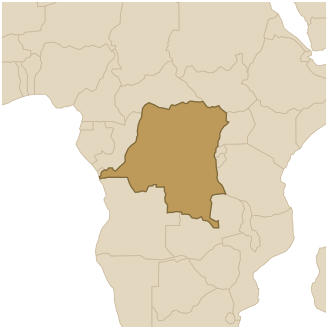
2nd largest in Africa
Lingala, Swahili, Kikongo, Tshiluba
At a glance
The Democratic Republic of the Congo, called Congo-Kinshasa to tell it apart from its neighbour, is a giant: the second-largest country in Africa, straddling the equator in the middle of the continent. More than 100 million people live there, from hundreds of different ethnic groups. Everything revolves around the Congo River, the second-largest in the world by volume, which gave the country its name and on whose banks the huge capital, Kinshasa, spreads out.
Geography
Most of the country is covered by the immense equatorial forest of the Congo Basin, the second largest in the world after the Amazon, home to bonobos, okapis and gorillas. The Congo River and its countless tributaries cross it in a great arc and serve as roads where there are none. At its edges the forest gives way to savanna, and in the east the land rises toward the Great Lakes and the volcanoes of the Rift. The ground is extremely rich in minerals: copper, cobalt, coltan.
Peoples and history
Before the Europeans, this land had powerful states, such as the kingdom of Kongo, whose kings dealt with Portugal as equals. Then came one of the darkest chapters of colonial history: in the late 19th century, King Leopold II of Belgium made the territory his personal property and subjected it to extremely brutal exploitation, above all for rubber, which cost countless lives. After becoming a Belgian colony, the country won independence in 1960, carried by the hopes placed in Patrice Lumumba, who was assassinated a few months later. Then came Mobutu's long dictatorship, during which the country was renamed Zaire, and then wars; the east of the country is still torn by armed conflict today.
Languages and religion
The DR Congo is one of the most multilingual countries in the world, with hundreds of languages. French, inherited from colonisation, is the official language and the language of school, and four major national languages are used as common languages by region: Lingala in Kinshasa and along the river, Swahili in the east, Kikongo and Tshiluba elsewhere. The country is overwhelmingly Christian, Catholic and Protestant, with powerful revivalist churches and churches founded in Africa, such as Kimbanguism, on an old base of respect for the ancestors.
Culture and way of life
The Congo's great art is music. Congolese rumba and soukous, with their glittering guitars, got the whole of Africa dancing and travelled far beyond, and the rumba is on UNESCO's intangible heritage list. Kinshasa is also the city of the sapeurs, dandies who make dressing well an art of living and a way of holding on to their dignity.