Congo
The country of the great river and the equatorial forest, on the equator, heir to the old Kongo kingdom, home of rumba and gorillas.
+ Lingala, Kituba
At a glance
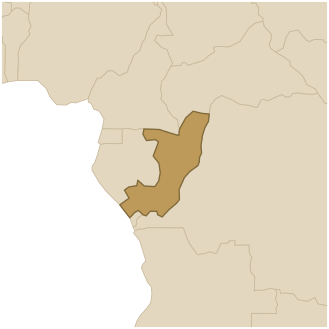
Congo, sometimes called Congo-Brazzaville to tell it apart from its huge neighbour, the Democratic Republic of the Congo, is a country in Central Africa, crossed by the equator and open to the Atlantic. Its capital, Brazzaville, faces Kinshasa across the Congo River: apart from Rome and the Vatican, they are the two closest capitals in the world. Six million people live there, mostly in towns. Covered in forest, rich in oil and heir to the old Kongo kingdom, the country is one of the birthplaces of rumba.
Geography
Much of Congo is covered in dense, humid equatorial forest, part of the great Congo Basin forest, the second-largest rainforest on the planet after the Amazon. In the north, the Cuvette and its vast swamps form one of the largest areas of tropical peatland in the world, home to gorillas and forest elephants. The Congo River and its tributary the Ubangi run along the border and are the country's main highway. In the south and near the coast there are plateaus, savannas and a narrow coastal plain around the port of Pointe-Noire.
History
The region was shaped by the great Kongo kingdom, one of the most powerful in Central Africa, which spread across both banks of the river; it traded with the Europeans, then suffered terribly from the Atlantic slave trade. In the late 19th century, the explorer Pierre Savorgnan de Brazza established a French presence and founded Brazzaville, which became the capital of French Equatorial Africa. Independent in 1960, the country went through a Marxist period, then civil wars in the 1990s, before a fragile peace returned.
Languages and faith
The official language is French, but daily life happens mostly in Lingala and Kituba, Bantu common languages that link the country's many peoples; Lingala, the language of the music, has spread far beyond the borders. Congo is mostly Christian, Catholic and Protestant, a legacy of the missions, with very active independent African churches such as Kimbanguism. Respect for the ancestors and traditional spiritual practices remain very present.
Culture and way of life
Congolese culture is best known for its music: the country is one of the birthplaces of Congolese rumba, born on both banks of the river, a sensual, festive music of rolling guitars that won over Africa and beyond and is on UNESCO's intangible heritage list. There are also the sapeurs, the dandies of Brazzaville who make dressing well an art of living. And there is the artistic legacy of the Kongo kingdom, its masks and statues. Life revolves around the river, cassava and fish, in very lively towns.