Colombia
The gateway to South America, the only country on the continent with coasts on both the Pacific and the Caribbean, a land of coffee, emeralds and magical realism.
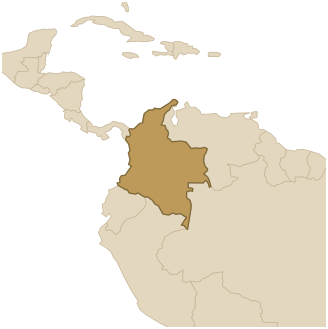
At a glance
Colombia occupies the north-western corner of South America and is its gateway: it is the only country on the continent with coasts on both the Pacific Ocean and the Caribbean Sea. With its two coastlines and its very rich nature, it is one of the most diverse countries on the planet, in its landscapes as in its peoples. Fifty-two million people live there, around the capital, Bogotá, high in the Andes, and in big cities such as Medellín and Cali.
Geography
The country brings several worlds together. In the west, the Andes split into three parallel ranges, with fertile valleys and the big cities between them; coffee grows on their deep green slopes. To the east open vast plains, the llanos, and then the Amazon forest. In the north are the warm Caribbean beaches and the old city of Cartagena; in the west, a wild and very rainy Pacific coast. This range of climates gives the country one of the richest biodiversities in the world.
Peoples and history
Before the conquest, many Indigenous peoples lived here, including the Muisca of the high plateaus, whose gold offerings thrown into a sacred lake gave rise to the legend of El Dorado, the land of gold the Spanish searched for in vain. Spanish colonisation made Cartagena one of the empire's great ports, a hub for gold and for the African slave trade. Independence was won by Simón Bolívar, the "Liberator", who for a time dreamed of uniting the region as Gran Colombia. In the 20th century the country was torn by a long armed conflict between the state, guerrillas and drug cartels, largely ended by the 2016 peace agreement. Today's Colombians, largely mestizo, were born of the meeting of Indigenous peoples, Spaniards and Africans.
Language and religion
Colombian Spanish is said to be one of the clearest in Latin America; dozens of Indigenous languages survive in remote regions. The country is Catholic by tradition, a faith brought by Spain that is very present in festivals and processions, and evangelical churches are growing. On the Caribbean and Pacific coasts, Afro-Colombian culture blends in rhythms and traditions from Africa.
Culture and way of life
Colombia is a country of music and festivals. Cumbia and vallenato, born on the Caribbean coast, and the salsa of Cali keep the whole country dancing. It is the homeland of Gabriel García Márquez, the Nobel laureate whose "magical realism" showed the world a legendary Colombia, and of the painter Botero and his rounded figures. It is also the land of famous coffee, of gold and emeralds, and of the Barranquilla carnival.