Comoros
A fragrant archipelago in the Indian Ocean, between Africa and Madagascar: the "islands of the moon", where the Swahili, Bantu and Arab worlds meet.
At a glance
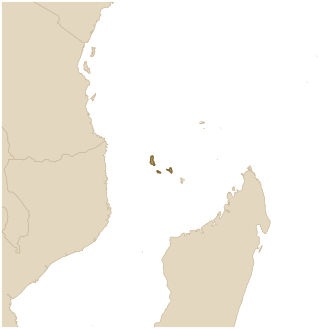
The Comoros are a small volcanic archipelago in the Indian Ocean, between the coast of East Africa and Madagascar, at the mouth of the Mozambique Channel. Their Arabic name means "islands of the moon". The country is made up of three islands; a fourth, Mayotte, stayed French. Fewer than a million people live there, around the capital, Moroni. The Comoros are a human crossroads, where the Bantu, Arab, Malagasy and Austronesian worlds meet. The country is poor and politically unstable, but known for its perfume plants and its natural beauty.
Geography
The Comoros are volcanic islands, mountainous and green. The largest, Grande Comore, is dominated by Karthala, one of the world's great active volcanoes, with a huge crater. The slopes are covered in forest and farmland, and the coasts alternate between black or white sand beaches, lagoons and coral reefs. The waters around the islands hold the main known population of coelacanths, a fish thought to have died out millions of years ago until it was rediscovered in the 20th century. The climate is tropical and humid, with cyclones.
History
Settled during the first millennium by Bantu peoples from Africa and by Austronesian seafarers who came, as to Madagascar, from Southeast Asia, the islands became a stop on the great Indian Ocean trade routes. Converted to Islam, they filled with prosperous sultanates linked to the Swahili, Arab and Persian worlds. Colonised by France in the 19th century, the Comoros became independent in 1975, but the island of Mayotte chose to stay French. The young state has since gone through chronic instability and many coups.
Language and faith
People speak Comorian (Shikomori), a Bantu language close to Swahili, full of Arabic words and long written in Arabic script; Arabic and French are also official. Comorians are almost all Sunni Muslims: Islam, which arrived with the Indian Ocean trade, shapes daily life, festivals and the law. Marked by Sufi brotherhoods, it sits alongside older beliefs.
Culture and way of life
The great event of Comorian social life is the grand marriage (anda), a lavish and very expensive ceremony that, once in a lifetime, sets a man's rank in society, with days of feasting, dancing and banquets. The Comoros are the world's largest producer of ylang-ylang, and also grow vanilla and cloves, which scent the islands and supply the perfume industry. There is twarab music, from the Swahili and Arab world, crafts and embroidery. People eat rice, fish, coconut and spices.