Cape Verde
A volcanic archipelago off West Africa, a Creole land born of the meeting of Africa and Portugal, home of morna and "sodade".
At a glance
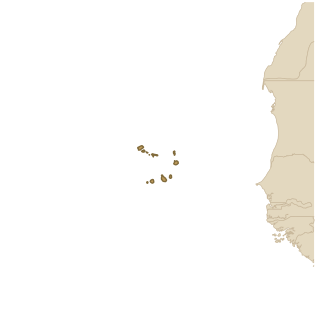
Cape Verde is an archipelago of ten volcanic islands in the Atlantic, a few hundred kilometres off Senegal. The islands were uninhabited when the Portuguese arrived: the Cape Verdean nation was born entirely of the meeting between Africa and Europe, and its people are deeply Creole. A little over half a million people live there, around the capital, Praia, and many more Cape Verdeans live abroad. Poor in resources, the country is known for its music and for its stable democracy.
Geography
Cape Verde is a volcanic archipelago of very different landscapes. Some islands are mountainous and green, with terraced valleys, such as Santo Antão; others are flat and dry, with long beaches, such as Sal and Boa Vista, popular with tourists. On the island of Fogo stands an active volcano whose crater holds a village and vineyards. The climate is Sahelian, dry and windy, marked by droughts and by the harmattan, which sometimes carries sand from the Sahara.
History
Found uninhabited by the Portuguese and settled from 1462, the islands soon became, thanks to their position, a hub of the Atlantic slave trade: African captives passed through on their way to the Americas, and their mixing with Portuguese settlers produced the Creole people. The following centuries brought terrible famines caused by drought, which drove generations of Cape Verdeans to emigrate; the diaspora is now larger than the population of the islands. Independent since 1975, the country has become one of the most stable and best-governed democracies in Africa.
Language and faith
The official language is Portuguese, but day to day everyone speaks Cape Verdean Creole (Kriolu), born of Portuguese and West African languages and one of the oldest creoles in the world. Cape Verde is overwhelmingly Catholic, a Portuguese legacy; the year is marked by patron saints' festivals, often coloured by traditions of African origin. Religion, music and family, at home and abroad, are at the centre of life.
Culture and way of life
Cape Verdean culture is first of all music, remarkably rich for such a small country. There is morna, a melancholy song that Cesária Évora, the "barefoot diva", made known all over the world; it sings of sodade, a bittersweet longing for absent people and for the homeland left behind, a feeling the whole country shares. There is also the livelier coladeira and the faster funaná. People drink grogue, a sugar cane spirit, and eat cachupa, a stew of maize and beans, the national dish.