Costa Rica
A small, green country in Central America between two oceans, a land of volcanoes and forests that abolished its army.
At a glance
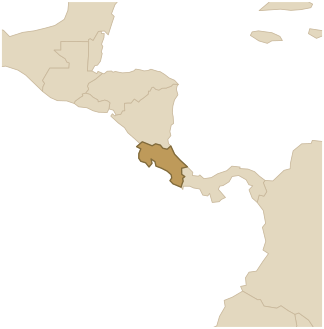
Costa Rica is a small country in Central America, the narrow strip of land linking the two Americas, with coasts on both the Pacific Ocean and the Caribbean Sea. Five million people live there, around the capital, San José, on a high plateau with a mild climate all year. The country is known for having abolished its army in 1948 and betting on education and nature; it often ranks among the countries whose people say they are happiest. Its favourite phrase, pura vida, "pure life", is used for everything.
Geography
Small as it is, Costa Rica is one of the world's richest countries in biodiversity: it is thought to hold nearly 6% of all species on the planet. A chain of volcanoes and green mountains runs through it, topped with cloud forests such as Monteverde. On either side, dense rainforests, rivers and beaches run down to two oceans. Sloths, monkeys, toucans, brightly coloured frogs and quetzals are everywhere. More than a quarter of the country is protected in national parks and reserves.
History
Home to Amerindian societies, between the Maya world to the north and South America, the region was named "Rich Coast" by the Spanish, who came looking for gold and found little. Poor, remote and thinly populated in colonial times, it developed a society of small farmers rather than large plantations, which fostered a tradition of equality. Independent from 1821, Costa Rica made a decision after a short civil war that would define it: it abolished its army in 1948 to invest in schools and healthcare. It has since been one of the most stable and prosperous democracies in Central America.
Language and faith
Costa Ricans speak Spanish with a soft accent and a fondness for diminutives ending in -tico, which earned them the nickname "Ticos". On the Caribbean coast, an English-based creole survives in communities of West Indian descent. The country is mostly Catholic, with a growing number of evangelicals; small Indigenous communities keep their traditions in remote areas.
Culture and way of life
Costa Rican culture is often summed up in two words: pura vida, a way of looking on the bright side, without stress, that people say for hello, thank you or goodbye. They love nature and ecotourism, coffee, of which the country grows some of the most prized in the world, and gallo pinto, rice and beans for breakfast. Ox carts painted in bright patterns are a national symbol.