Cuba
The largest island in the Caribbean, a land of sugar and music, born of the mixing of Spain and Africa, whose rhythms have spread around the world.
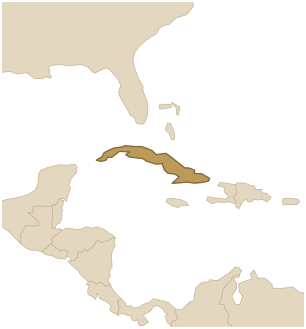
largest island in the Caribbean
At a glance
Cuba is the largest island in the Caribbean, a long ribbon of land at the mouth of the Gulf of Mexico, less than two hundred kilometres from Florida. About ten million people live there, around the capital, Havana, whose old town of brightly painted façades and 1950s American cars seems frozen in time. Born of the meeting of Spain and Africa, Cuba has a strong identity and a cultural influence, above all in music, far beyond its size.
Geography
The island is mostly plains and low hills, with fertile soil suited to sugar cane and tobacco, and a few mountain ranges such as the Sierra Maestra in the east. All around are white-sand beaches, mangroves and coral reefs, under a tropical climate shaped by the rainy season and the risk of hurricanes. In the west, the Viñales Valley, where some of the world's most famous tobacco is still grown the traditional way, is dotted with mogotes, rounded limestone hills.
Peoples and history
The island was home to the Taíno when Christopher Columbus landed there in 1492, on his first voyage. Spanish colonisation wiped out these first inhabitants and turned Cuba into one huge sugar plantation; to work it, the island became one of the main destinations of the African slave trade, whose legacy is everywhere in Cuban culture. One of Spain's last colonies in the Americas, Cuba became independent in 1902 under United States tutelage, until the revolution of Fidel Castro and Che Guevara in 1959 changed its course.
Language and religion
Cubans speak a quick, musical Spanish, full of expressions and words from Africa. Religion has two intertwined faces: Catholicism, brought by Spain, and above all Santería, an Afro-Cuban religion created by enslaved people who hid their African gods, the Yoruba orishas, behind Catholic saints. With its drums, songs and colours, it runs through the island's life and music.
Culture and way of life
Cuba is a musical powerhouse. From this island came son, rumba, mambo, cha-cha-cha and what would become salsa: rhythms born of Spanish guitars meeting African drums, which got the whole world dancing, all the way to the Buena Vista Social Club. It is also the land of the cigar and of rum, of baseball, and of the poet José Martí.