Curaçao
A Dutch island in the southern Caribbean, once a hub of the slave trade, home of Papiamento and of a colourful harbour on the World Heritage list, with a very mixed population.
+ Spanish, English
At a glance
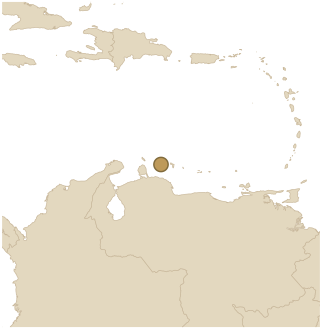
Curaçao is the largest of the Dutch islands in the southern Caribbean, off Venezuela; it is an autonomous country within the Kingdom of the Netherlands. About 155,000 people live there, around the capital, Willemstad, known for its pastel Dutch-style merchant houses lined up along the water, a World Heritage Site. The population is very mixed, shaped by the island's past as a great hub of the slave trade; it speaks Papiamento, and the island is home to one of the oldest Jewish communities in the Americas. Dry and sunny, Curaçao lies outside the hurricane belt.
Geography
Like its neighbours, Curaçao is a dry island swept by the trade winds, nothing like the usual tropical picture: cactus, divi-divi trees and rocky hills, dominated by Mount Christoffel. The coast has small white-sand coves between cliffs, and very rich sea life that draws divers. The capital surrounds a deep bay, a large natural harbour crossed by a floating pontoon bridge. Outside the hurricane belt, the island is hot and dry.
History
Home to the Caquetío Amerindians, the island was taken in 1634 by the Dutch, who made it a major trading and military base. Curaçao became one of the main hubs of the Atlantic slave trade: tens of thousands of Africans were landed, held and then sold on across the region. The island also took in Sephardic Jews fleeing the Inquisition, who founded the oldest synagogue in the Americas still in use. In 1795 a great slave revolt, led by Tula, left a lasting mark on the island's memory. After the oil refinery era of the 20th century, Curaçao became an autonomous country within the Kingdom of the Netherlands in 2010.
Language and faith
Curaçao speaks Papiamento, a creole born in these islands, Iberian-based with Dutch, African and Judeo-Spanish elements, along with Dutch, English and Spanish. The island is overwhelmingly Catholic, with Protestant communities and the old Sephardic Jewish community, whose synagogue in Willemstad has a sand-covered floor. Popular Catholicism here sometimes keeps traditions inherited from Africa.
Culture and way of life
Curaçao's culture is deeply mixed: African heritage dominates, blended with European, Latin American and Jewish influences. There is tumba, the queen of carnival music and dance, tambú inherited from the slaves, and a lively cultural scene. There are Willemstad's pastel façades, local crafts, the blue Curaçao liqueur made from a bitter orange grown on the island, and a living memory of slavery. Creole cooking serves keshi yena (stuffed cheese), fish, iguana stew and funchi, a cornmeal polenta.