Christmas Island
A remote Australian island in the Indian Ocean, a land of phosphate and of the red crab migration, whose people are mostly of Chinese and Malay descent.
+ Mandarin, Malay
At a glance
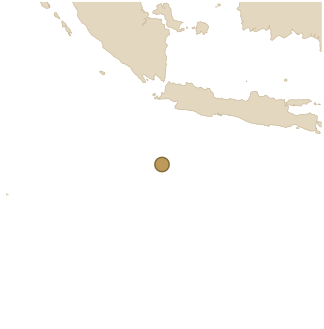
Christmas Island is a remote Australian island in the Indian Ocean, much closer to Indonesia (Java) than to Australia. An Australian territory, it has about 1,700 people, around the small harbour of Flying Fish Cove. Most of the population is of Chinese and Malay origin, with a European minority: a legacy of phosphate mining, which brought in workers from Asia. The island is known worldwide for the yearly migration of tens of millions of red crabs, which cross it to reach the sea.
Geography
Christmas Island is the top of an undersea volcanic mountain: a plateau ringed by sheer cliffs that drop straight into a very deep ocean, which draws divers. Dense rainforest covers most of the island, much of it protected as a national park, home to unique wildlife: rare seabirds, and above all the red crabs and coconut crabs. Every year the migration of millions of red crabs to the sea covers the island in a moving carpet. The climate is tropical, hot and humid.
History
Uninhabited, with no native population, the island was named by English sailors on Christmas Day, 1643. The discovery of rich phosphate deposits changed its fate: annexed by Britain in 1888, it was mined by a company that brought in thousands of Chinese, Malay and Indian workers, the ancestors of most of today's population. During the Second World War the island was occupied by Japan. In 1958 it came under Australian sovereignty. Phosphate mining is in decline today; the island also lives from its nature and houses an immigration detention centre.
Language and faith
English is the official language, but Mandarin, other Chinese languages and Malay are also spoken every day. Religions coexist peacefully: the Buddhism and Taoism of the Chinese, with their colourful temples, the Islam of the Malay community and its mosque, and Christianity and Hinduism. Each community's festivals, such as Chinese New Year or the Muslim holidays, are celebrated by everyone.
Culture and way of life
Christmas Island's culture is multicultural and Asian, born of the meeting of Chinese, Malay and European communities around phosphate mining. Temples, mosques and churches stand side by side, and festivals are shared: Chinese New Year with its lion dances, Ramadan, Tamil festivals. Nature plays a big part: people watch the red crabs, the birds and the reefs. The food mixes the flavours of Asia: Chinese dishes, Malay nasi and laksa, curries and fresh fish.