Cyprus
An island at the meeting point of three continents, where legend says Aphrodite was born, a land of copper, Greek and Turkish, split in two since 1974.
+ Turkish
At a glance
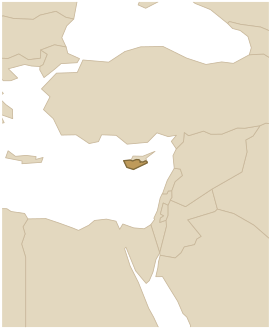
Cyprus is a large island in the eastern Mediterranean, the third largest in the sea, between Europe, Asia and Africa, very close to the coasts of Turkey and the Levant. Mostly Greek in culture, it has long linked East and West. A little over a million people live there, around the capital, Nicosia, the last divided capital in the world: since 1974 a Green Line has cut it in two, between the Greek south and the Turkish north.
Geography
Two mountain ranges frame a central plain. In the south-west rises the Troodos range, with its pine forests, villages and monasteries, snow-capped in winter; in the north runs the long ridge of the Pentadaktylos. Between them lies the Mesaoria plain, the island's breadbasket. All around, the coast alternates between beaches, coves and places tied to myth, such as Aphrodite's Rock, where legend says the goddess of love rose from the sea foam. The hot, dry climate suits vines and olive trees.
History
Cyprus has been inhabited since the beginning of the Neolithic, and some of the oldest villages in the world are found here. In ancient times the island grew rich on copper, which is even named after it, and was dotted with Greek city-kingdoms. Much coveted, it passed from hand to hand: Phoenicians, Greeks, Romans, Byzantines, Crusaders, Venetians, Ottomans, then the British. Independent from 1960, the island went through a tragedy in 1974: a coup aimed at union with Greece triggered a Turkish military intervention and the de facto partition of the island, which has kept the Greek and Turkish communities apart ever since.
Languages and faith
Cyprus has two official languages, those of its two communities: Greek, spoken by the majority in the south in a Cypriot dialect, and Turkish, in the north. Greek Cypriots are Orthodox Christians, belonging to the Church of Cyprus, one of the oldest in the world, founded according to tradition by the apostles Paul and Barnabas; the frescoed Byzantine churches of the Troodos are its finest monuments. Turkish Cypriots are Muslim. The religious line matches the division of the island.
Culture and way of life
Cypriot culture is Mediterranean and Greek, with touches of the East. Much of life happens at the table: meze, a long run of small shared dishes, halloumi, a grilling cheese born here, olives, and wine, including commandaria, one of the oldest named wines in the world. There are the mountain villages, Lefkara lace and silverwork, religious festivals and dances, hospitality (philoxenia) and Cypriot coffee.