Czechia
A country in the middle of Europe, the land of Bohemia and Moravia, home of Prague, castles and beer.
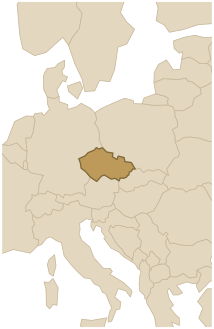
At a glance
Czechia is a landlocked country in the middle of Europe, surrounded by Germany, Poland, Austria and Slovakia. It brings together two old lands: Bohemia in the west, around Prague, and Moravia in the east. Nearly eleven million people live there, around the capital, Prague, largely spared by the wars, with its countless spires and medieval lanes. It is a country of old culture and industry, long the meeting point of the German and Slavic worlds.
Geography
Bohemia is a basin ringed by wooded mountains and deep forests, crossed by the Vltava, the river Smetana set to music, which flows through Prague. The country alternates between gentle hills, fields, forests and villages gathered around their church tower. There are elegant spa towns, castles by the hundred, more than in any other European country for its size, and, in Moravia, fine vineyards.
History
The kingdom of Bohemia was one of the great states of medieval Europe. In the 14th century its king, Charles IV, who became emperor, made Prague the capital of the Holy Roman Empire and founded the first university in central Europe there. It was here, a century before Luther, that the reformer Jan Hus defied the Church; he was burned in 1415, which set off the Hussite wars. Long under Habsburg rule, the Czechs joined the Slovaks in 1918 to form Czechoslovakia, which endured Nazi occupation and then communism until the peaceful "Velvet Revolution" of 1989. In 1993 Czechs and Slovaks went their separate ways by mutual agreement.
Language and faith
Czech is a West Slavic language, close to Polish and Slovak, known for being hard because of its strings of consonants. Long Catholic under the Habsburgs, Czechia is today one of the most secular countries in the world, where most people claim no religion. Yet the Christian heritage is visible everywhere: Gothic cathedrals, baroque statues on the bridges, monasteries, villages clustered around their church.
Culture and way of life
Czech culture is that of an old country of artists. There is the music of Dvořák and Smetana; the writing of Kafka, born in Prague, and the humour of The Good Soldier Švejk; puppets, theatre, design and Bohemian glass. In everyday life, above all, there is beer: Czechs drink more of it per head than any other people, and it was in Plzeň that golden pilsner was born, now drunk all over the world. Much of social life happens in the pub, over a tankard and a plate of pork, cabbage and knedlíky (bread dumplings).