Germany
The centre of the European continent, a land of forests, rivers and cities, long divided into many states before becoming one of the world's great powers.
reunified in 1990
At a glance
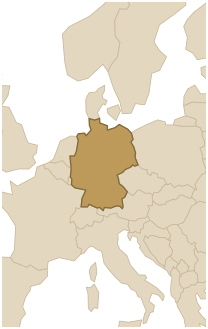
Germany sits in the middle of Europe, with no natural border to protect it: it touches nine countries, more than any other member of the European Union, which has made it, throughout history, a crossroads and a battlefield. With about 84 million people, it is the most populous country in the Union and one of the world's leading economies. For centuries it was a collection of kingdoms, principalities and cities rather than a nation; its capital, Berlin, reunified in 1990, still shows it.
Geography
The land slopes gently from south to north. In the south rise the Alps and their foothills, with the Bavarian lakes, then medium-height mountains covered in fir, such as the Black Forest. The centre is hills and old, worn-down ranges, while in the north the land flattens into a great plain that runs to the North Sea and the Baltic. Great rivers full of history and legend cross the country: the Rhine with its castles, and the Danube, heading east.
Peoples and history
On the edge of the Roman Empire lived the Germanic tribes, whom Rome never managed to subdue for long. Their world gave rise, in the Middle Ages, to the Holy Roman Empire, a vast patchwork of hundreds of principalities. It was here, in 1517, that a monk, Martin Luther, launched the Reformation, which split Christian Europe in two. Not until 1871 did Bismarck unite these territories into a single German Empire. The 20th century was tragic: two world wars, the barbarity of Nazism and the Holocaust, then a country cut in two by the Berlin Wall, until peaceful reunification in 1990.
Language and religion
German is a Germanic language, related to English and Dutch, known for its long compound words that fit ideas inside one another. It is the most widely spoken mother tongue in the European Union. The Reformation long divided the country: the north and east mostly Protestant, the south and west mostly Catholic. Luther's translation of the Bible helped shape modern German. The country is now largely secular.
Culture and way of life
Germany has given a great deal to thought and music: it is the homeland of Bach, Beethoven and Brahms, of the philosophers Kant, Hegel and Nietzsche, of Goethe and the Brothers Grimm. It is also a country of engineers and craftsmanship, whose cars are driven all over the world. People love the brightly lit Christmas markets, beer festivals such as Oktoberfest, hundreds of kinds of bread and sausage, the forest and a good walk.