Djibouti
A small volcanic country guarding the entrance to the Red Sea, a land of salt lakes and moonscapes, at a strategic crossroads between Africa and Arabia.
+ Somali, Afar
At a glance
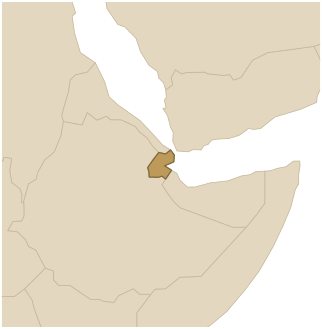
Djibouti is a small country in the Horn of Africa, at a strategic point: it guards the strait of Bab-el-Mandeb, the "gate of grief", a narrow passage between the Red Sea and the Indian Ocean through which a huge share of world trade passes. A little over a million people live there, more than half of them in the capital, Djibouti, around a large port. Peopled mainly by Somalis and Afars, the country owes everything to its position: major powers have set up military bases there, and its port is the main outlet to the sea for landlocked Ethiopia.
Geography
Djibouti is a volcanic desert country whose landscapes look like another planet. It sits where three of the earth's tectonic plates meet, where the continent is slowly tearing apart: hence its lava fields, its volcanoes and the limestone chimneys of Lake Abbe. Here is Lake Assal, a huge salt lake, the lowest point in Africa and one of the saltiest lakes in the world. In the Gulf of Tadjoura you can swim with whale sharks. The climate, one of the hottest and driest on the planet, makes water and shade precious.
History
This coast has always been a crossing point for Red Sea trade, between Africa, Arabia and Asia. In the late 19th century France made it a colony, French Somaliland, to have a port of call on the route to Indochina, and built a railway to Ethiopia. The territory became independent in 1977, one of the last in Africa to do so. Since then the small country has turned its position into an asset: its modern port and the foreign military bases make it an anchor point in an unstable region.
Languages and faith
Djibouti has two official languages, French, inherited from colonisation, and Arabic, but people speak Somali and Afar in daily life, the languages of its two main peoples, both Cushitic. The country is almost entirely Sunni Muslim: Islam, which arrived very early through the Red Sea trade, shapes social life, festivals and the calendar.
Culture and way of life
Djiboutian culture is that of the Somali and Afar peoples, nomadic herders of the dry lands, with Arab and French influences. Traditional life revolves around the camel, wealth and companion in the desert, and around the camps. Oral poetry is a major art among the Somalis, and festivals have their dances and songs. Khat, a plant chewed in the afternoon during long conversations, is an institution. People eat Red Sea fish, spiced rice, camel or goat meat and bread.