Dominican Republic
Two-thirds of the island of Hispaniola, in the Caribbean, home of merengue and bachata, where the Spanish founded the first European city in the Americas.
At a glance
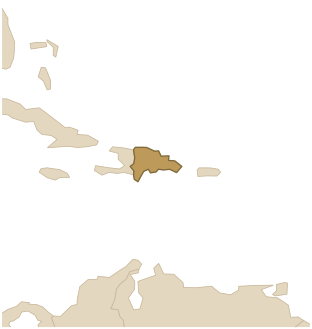
The Dominican Republic covers the eastern two-thirds of the island of Hispaniola, in the Greater Antilles, which it shares with Haiti. With more than eleven million people, it is one of the most populous countries in the Caribbean; its capital, Santo Domingo, is the oldest European city in the Americas. A land of beaches, mountains and music, and a major tourist destination, the country is mixed: Spanish, African and Amerindian heritage come together here.
Geography
The island is very varied: in the middle rise high green mountains, the Cordillera Central, with Pico Duarte, the highest peak in the Antilles, where it can freeze. Around them lie fertile valleys, sugar cane plains and long white-sand beaches lined with coconut palms, among the best known in the Caribbean, from Punta Cana to Samaná. The country also has desert areas and the lowest point in the Antilles, Lake Enriquillo, a salt lake. The tropical climate is cooled by the trade winds, but the island lies in the path of hurricanes.
History
The island was home to the Taíno when Christopher Columbus reached it in December 1492, on his first voyage; the Spanish founded Santo Domingo there, which claims the first cathedral and the first university in the Americas. The native population was wiped out within a few decades, and captive Africans were brought in for the plantations. The island was later contested between the Spanish and the French. The eastern part won independence in 1844, not from a European power but from Haiti, which had occupied it since 1822. In the 20th century the country lived through the long, brutal dictatorship of Trujillo, before opening up to democracy and tourism.
Language and faith
Dominicans speak Spanish, with a fast, musical Caribbean accent and plenty of local expressions. The country is mostly Catholic, a Spanish legacy, with a growing number of evangelicals; as elsewhere in the Caribbean, beliefs of African origin run beneath this faith. Patron saints' festivals and popular devotion play a large part in life.
Culture and way of life
The Dominican Republic is a country of music and dance. It is the birthplace of merengue, the national rhythm, and bachata, slower and more romantic, both now danced all over the world. Baseball is a passion, and the country has supplied the American major leagues with many of their best players. People eat mangú, mashed plantains, for breakfast, and sancocho, a stew of meats and vegetables; they drink rum and coffee.