Algeria
The largest country in Africa, stretching from the Mediterranean to the Sahara.
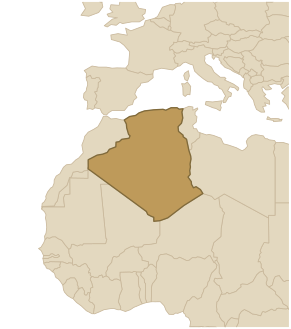
1st country in Africa
+ French, in everyday use
At a glance
Algeria is the largest country in Africa, more than four times the size of France, and yet one of the least known from the outside. It lies at the centre of the Maghreb, the North Africa that faces the Mediterranean, between Morocco to the west and Tunisia and Libya to the east. Almost everything is organised along a north–south axis. In the north, a long Mediterranean coast and a narrow strip of fertile land are home to almost all of Algeria's 47 million people, in big cities such as the capital, Algiers. To the south begins a completely different world, vast and almost empty: the Sahara.
Geography
From north to south, the country steps down like a staircase. First comes the Tell, the green, farmed coastal strip with its mild Mediterranean climate: here are Algiers "the White", with its old casbah above the bay, Oran, facing Spain, Constantine, clinging to the cliffs of its gorges, and Béjaïa at the foot of its mountains. Behind the coast rise the ranges of the Atlas, then high steppe plateaus where sheep are raised. Then, past one last mountain range, everything gives way to the Sahara: dunes, stony plateaus, palm oases and, far to the south, the volcanic mountains of the Hoggar. On the rock walls of the Tassili n'Ajjer, thousands of paintings show giraffes and herds: proof that this desert was once a green savanna.
Peoples
Above all, Algeria is a Berber land. The Berbers (who call themselves Imazighen, "the free people") are the oldest people of all North Africa. They do not form a single bloc but several peoples: the Kabyles of the mountains east of Algiers, the Chaouis of the Aurès, the Mozabites of the M'zab oases, the veiled Tuareg of the far south. Each has kept its own language and customs.
Then, from the 7th century and above all with the great Bedouin migrations of the 11th, came the Arabs, who brought Islam and the Arabic language. Over the centuries much of the country adopted Arabic, so that Algeria today is mostly Arabic-speaking, on a Berber base that is still very much alive. Other peoples added to the mix: the Andalusians driven out of Spain, who settled in the northern cities; the Ottoman Turks; the Black populations of the Sahara; and, until 1962, a very old Jewish community and nearly a million Europeans.
History
The history of this land is that of a crossroads everyone wanted to hold. In ancient times it was the Berber kingdom of Numidia, ruled by King Masinissa. Rome then made it one of its richest provinces (African wheat fed the city of Rome) and left whole cities that can still be visited, such as Timgad and Djémila; it was on this land, too, that a Berber was born who became one of the greatest thinkers of Christianity, Saint Augustine. Then came Islam in the 7th century, a long line of dynasties, and the Ottoman regency of Algiers with its corsairs. In 1830 France invaded the country: Emir Abd el-Kader led fifteen years of resistance, before a hundred and thirty years of harsh colonial rule. Everything came to a head in the war of independence (1954–1962), one of the bitterest of the century, which ended with independence in 1962.
Languages
Algerians speak several languages at once, often in the same sentence. First Arabic: the Arabic of school and, above all, everyday Algerian Arabic, darja, full of Berber, Turkish and French words. Then Tamazight, the Berber language, long ignored and made an official language in 2016. And finally French: a legacy of colonisation, widely used in higher education, business and the media without being official.
Religion
Algeria is overwhelmingly Muslim, following Sunni Islam of the Maliki school, closely woven into daily life. Alongside the mosque, a more popular religion long flourished: that of saints and Sufi brotherhoods, the marabouts and their shrines. A distinct minority, the Ibadis of the M'zab, follow their own branch of Islam. And the land remembers older faiths: one of the oldest Jewish communities in the world, and the Christianity of Roman Africa, whose great figure is Saint Augustine.
Culture and way of life
Music may be the best way into Algeria, it has so many kinds: raï, born in Oran and carried around the world by Cheb Khaled; the chaabi of the Algiers casbah; the classical Andalusian music inherited from Muslim Spain; and the great Kabyle song tradition. At the table, almost everything revolves around couscous, the national dish, on UNESCO's intangible heritage list, with chorba soup, merguez sausages and honey pastries. Football is a national passion.