Ecuador
The country named after the line that divides the world in two, a land of Andean volcanoes, Amazon forest and the Galápagos Islands.
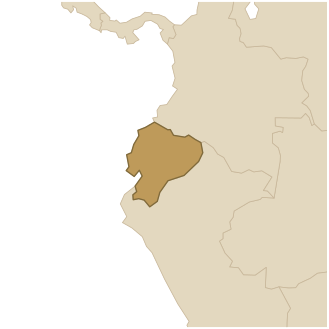
+ Quechua
At a glance
Ecuador takes its name from the imaginary line that crosses it, the equator, which you can straddle near Quito with a foot in each hemisphere. It is one of the smallest countries in South America but one of the most varied: in a small area it has the high Andes, the Amazon rainforest, the Pacific coast and, offshore, the Galápagos Islands. Eighteen million people live there, around the capital, Quito, which stands at more than 2,800 metres.
Geography
Ecuador falls into bands: the hot, fertile Pacific coast, with its banana and cocoa plantations; in the centre, the Andean sierra, a double row of snow-capped volcanoes, including Cotopaxi and Chimborazo, whose summit, because the earth bulges at the equator, is the point on its surface farthest from its centre; to the east, the vast Amazon lowlands (the Oriente), primeval forest and rivers. Far out in the Pacific, the volcanic Galápagos Islands helped Darwin work out his theory of evolution.
History
Home to Andean and Amazonian cultures for a long time, the territory was absorbed into the Inca empire in the 15th century, and Quito became its second capital, north of Cusco. The Spanish conquest then brought three centuries of colonial rule, mixing and conversion to Christianity. Independence came with the campaigns of Bolívar and Marshal Sucre; the country was first part of Gran Colombia, then became the Republic of Ecuador in 1830. Its modern history has swung between oil wealth and political instability.
Languages and faith
Ecuadorians speak Spanish and, in the highlands, Quechua (Kichwa), a living Inca legacy, as well as other Amerindian languages in the Amazon. The country defines itself as plurinational. Ecuador is mostly Catholic, with a fervent, colourful faith: great processions and patron saints' festivals often blend with Andean traditions, such as sun festivals and the worship of Mother Earth, the Pachamama.
Culture and way of life
Ecuadorian culture is mestizo and Andean. There is Quito's historic centre, one of the best preserved in the Americas, and the colourful Indigenous markets, such as Otavalo, where artisans in traditional dress sell well-known weavings and ponchos. There is Andean music of flutes and charangos, and the great sun festivals. The food ranges from coastal ceviche to locro, an Andean potato soup, and the country grows some of the finest cocoa in the world.